
Do You Have Melungeon Ancestors? Here’s Where to Start
Heart of the Family is a participant in the Amazon Services LLC Associate Programs and other affiliate services. This means that thefamilyheart.com receives a small commission by linking to Amazon.com and other sites at no cost to the readers.
If your ancestors lived in east Tennessee, southwest Virginia, or the northwest North Carolina region of the Appalachian Mountains, you may have Melungeon roots in your family tree. The term “Melungeon” describes a group of people from the Southern United States whose ancestry is richly diverse — and, for many researchers, fascinatingly difficult to trace.
What is a Melungeon?
Sometimes called the “Lost Tribe of Appalachia,” Melungeons have been the subjects of many myths and competing theories. Rumored to be descendants of shipwrecked Portuguese sailors, Romani travelers, or even survivors of the Lost Colony of Roanoke, their true origins were debated for generations.
According to the Melungeon Heritage Association, the term “Melungeon” is thought to derive from the French word mélange, meaning “mixture.” It first appeared in print in 19th-century Virginia, Tennessee, and North Carolina, used to describe people thought to have a mixture of European, Native American, and African ancestry.
Other proposed origins of the word include the Afro-Portuguese melungo (supposedly meaning “shipmate”), the Greek melan (meaning “black”), the Turkish phrase melun can (meaning “cursed soul”), the Italian melongena (meaning “eggplant”), or the old English term “malengin” (meaning guile or deceit). While the term clearly did not originate as a compliment, many of today’s Melungeon descendants proudly acknowledge their unique and diverse heritage.
What Does Current Research Tell Us?
Scholarly research has increasingly clarified the picture. Genealogical and genomic work has traced Melungeon family lines to free people of color in 17th- and 18th-century Virginia, European settlers predominantly from the British Isles, and Indigenous Americans — not a single tribe or isolated ethnic enclave, but a regional community shaped by frontier fluidity and intermarriage.
Many 18th-century Melungeon people were referred to by neighbors as “Black Dutch,” “Black German,” or “French.” Some families adopted these coded descriptions in census records to avoid social discrimination, a pattern that has important implications for genealogical research: an ancestor who appears as “Black Dutch” in early records may be pointing you toward Melungeon heritage.
In North Carolina, mountain counties such as Alleghany, Mitchell, Ashe, and Yancey are recognized as the historical homes of many Melungeon families, which is worth knowing if your research extends beyond the Tennessee and Virginia hotspots.
Geographic Locations
Did your ancestors live in or near known Melungeon communities? Your ancestor’s specific geographic location may be one of your best clues.
The most well-known Melungeon community is in Hancock County, Tennessee. Other communities have been documented in Hawkins County, Tennessee, as well as Lee, Scott, and Wise Counties in Virginia. From these areas, many Melungeons and their descendants migrated to other parts of Tennessee, southeastern Kentucky, West Virginia, and as far north as Ohio.
Physical Traits
Typical Melungeon physical traits are said to include dark hair and skin with light-colored eyes, “Native American features,” and a particular ridge at the back of the skull sometimes called the “Melungeon bump.”
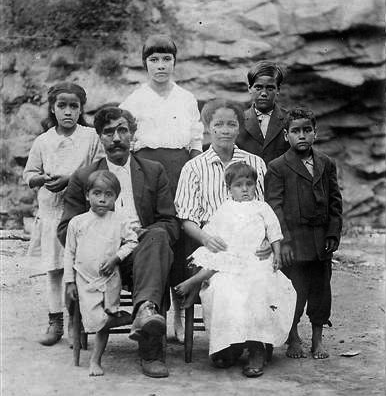
Kathy Lyday, a professor at Elon University in North Carolina, has noted that in older photographs, the physical appearance of Melungeons can look almost Mediterranean or Middle Eastern — consistent with what researchers now understand about the Spanish and Portuguese presence in early Appalachia. According to Professor Lyday, Spanish explorers traveled as far inland as modern-day Morganton and likely intermarried with African and Native American populations before retreating, leaving families behind.
A word of caution: physical traits alone are never a reliable basis for determining ancestry, and should be considered alongside documentary and DNA evidence.
Melungeon Surnames
Because Melungeons did not self-identify as such until the 1960s, and no tribal rolls or similar records were ever created, surnames are one of the most accessible entry points for research.
The Melungeon Heritage Association identifies the earliest recorded Melungeon surnames as:
- Bunch
- Bowlin
- Collins
- Denham
- Gibson
- Goins
- Mullins
Other possible Melungeon surnames include:
- Bowling
- Chavis/Chavez
- Epps
- Evans
- Fields
- Francisco
- Gill
- Goodman
- Minor
- Mise
- Moore
- Osborn(e)
- Phipps
- Reeves/Rives/Rieves/Reeves/ Reaves
- Ridley/Riddle
- Rodrigues
- Stowers
- Vanover
- Williams
- Wise
Of course, not every family using these surnames was Melungeon. But if these surnames appear in your tree and your ancestors lived in or near known Melungeon communities, further research is warranted.
One important tip for census research: census takers and clerks were inconsistent, labeling the same families as “mulatto,” “Indian,” “free Negro,” or “other free person” across different decades. These shifting classifications can obscure a Melungeon connection, but they can also be a signal that you’re on the right track.
Genetic Genealogy (DNA) Research
There is no specific “Melungeon gene,” but DNA research has contributed significantly to our understanding of Melungeon origins.
A landmark 2011 study published in the Journal of Genetic Genealogy — authored by Roberta J. Estes, Jack H. Goins, Penny Ferguson, and Janet Lewis Crain — determined that the core Melungeon families were largely the descendants of sub-Saharan African men and women of northern or central European origin, with some Native American ancestry present in specific lines. The paper received the Paul Green Multimedia Award from the North Carolina Society of Historians in 2012.
Y-DNA testing showed that paternally, the majority of participants had either Western European or sub-Saharan African ancestry, with only the Sizemore paternal line showing Native American origins. Six women whose mitochondrial DNA was tested revealed European maternal lines, though the authors acknowledged the sample size was small.
If you’re considering DNA testing as part of your research, there are two dedicated projects worth knowing about:
- The Melungeon Core Y-DNA Project at FamilyTreeDNA focuses on paternal lines through the surname and is open to male descendants of core Melungeon families.
- A Melungeon mtDNA Project at FamilyTreeDNA is available to both men and women who have a Melungeon ancestor in their direct maternal line.
As always, DNA evidence is most powerful when combined with traditional documentary research. Autosomal DNA results showing European, sub-Saharan African, or Native American admixture are consistent with Melungeon ancestry, but they are not, by themselves, proof of it.
Resources for Further Research
The following resources are useful for researching Melungeon ancestry:
Organizations & Associations
- Melungeon Heritage Association — hosts an annual gathering and maintains research resources
- Melungeon Historical Society — East Tennessee focus
DNA Projects
- Melungeon Core Y-DNA Project at FamilyTreeDNA
- Melungeon mtDNA Project at FamilyTreeDNA
- Melungeon Families of Interest Project at FamilyTreeDNA (for those without qualifying Y or mtDNA results)
Wikis & Online Reference
- Melungeon Genealogy — FamilySearch Wiki — well-maintained with current links
- Melungeon Roots on WikiTree — collaborative genealogy profiles
- NCpedia: Melungeon People — strong North Carolina focus with updated bibliography
Blogs & Expert Research
- DNAeXplained – Genetic Genealogy by Roberta Estes — extensive archive of Melungeon DNA analysis
- Jack Goins’ Melungeon and Appalachian Research — primary source documentation from the Hawkins County archivist
- Melungeon Roots Resource Center — actively updated with books, articles, and multimedia
Academic
- Estes et al., “Melungeons, A Multi-Ethnic Population,” Journal of Genetic Genealogy, Fall 2011 — the foundational DNA study, freely available online
- Tennessee Encyclopedia: Melungeons
Putting It All Together
Melungeon ancestry sits at the intersection of race, identity, and the complicated history of early America. Because records are often incomplete, inconsistently labeled, or deliberately obscured, this is research that rewards patience and a multi-pronged approach.
If you find Melungeon-associated surnames in your tree, ancestors who lived in core Melungeon counties, and DNA results showing the expected mix of European, African, and Native American ancestry — taken together, those are meaningful clues. But as with all genealogical research, no single piece of evidence tells the whole story. Combine your DNA findings with census records, church records, land deeds, and the specialized resources above to build the strongest possible case.
Have you found a Melungeon in your family tree? Share your experience in the comments. Your discoveries may help other researchers!


This post contains affiliate links. I may receive a small commission if you choose to make a purchase, but it does not add anything extra to the price you pay. For more, please read my full Disclosure Statement. I appreciate your support!



Very interesting! I’d never heard of this group of people.
I first heard about Melungeons many years ago but didn’t have a chance to look into them more in depth until recently. I was actually inspired by an assignment for a Toastmaster’s speech; I had to research a subject that I either didn’t know about or that I wanted to know more about, so… Melungeons! I decided to turn the speech into a blog post after presenting the speech since I had already done the research. 🙂
Discovered my melungeon heritage through 23&Me. My original African ancestor was Joao Gonwelao of the former country of Ndongo, who was transported to Jamestowne Colony in 1619. I also have twice as much Portugese ancestry as African and believe the two cultures intermarried. The Kimbuntu word for shipmate is melangú which is the language group of Ndongo. Joao became John and Gonwelao became Goings. He was of mixed race ancestry before he arrived. He worked as an indentured servant and after his indenture became the first free black man in America.
Amazing history. My grandmother always spoke of our Melungeon heritage, and was an avid genealogist, but didn’t have the resources we have today. I have barely begun my research, and would love pointers on how to find those hard-to-locate records. My GGGG grandfather, Enoch Gibson and his father, Martin Gibson are listed as “Melungeon” in family history. Could you give me pointers on where to start researching where their Melungeon lines come from? Martin was the first one born here in America; his father, Thomas Gibson, was born in British America. My dad’s DNA testing showed 3% Congan ancestry. I appreciate any direction you are able to offer.
Very interesting! Thanks for sharing.
My fathers mothers surname is Bolin or Bowlin who was from Cumberland Gap area. I have always been told we have Melungeon blood line. Only recently has this interest me. If anyone has more information or books that may be of interest please reply to me.
Thank you.
Paula
It’s great how you learn so much from the research others do by reading family history blogs.
I’m glad you found it helpful, Fran!
I’m blown away by seeing this I have researched my family for sometime now dark hot hair dark skin high cheekbones majority of the families got dark eyes I come out with blue eyes cannot find where my grandmother great grandfather has said that we’ve had Indian in us black foot and Cherokee but my ancestry DNA come back there was no Indian that did not show up any Indian anywhere so maybe this answers you know why I don’t show up Indian because not actual full-blooded Indian anywhere thank you for sharing this and where can I find more about this and read about it because my family come over from northern Europe and landed Georgia Tennessee Kentucky North Carolina
Ancestry didn’t show any Native American in my DNA either. My sister took their DNA test for the mother’s side only (that was a big mess), when we called them for an explanation they told her that it was full of native american ancestry. I ask them why mine wouldn’t be there as well. She told me that a lot showed up in mine also. So, why isn’t it in the chart?????
Bottom line, I’m sure they just guess at the Native American because they probably don’t have anything to compare it to.
I have 3 different blood lines that listed on their military paperwork that they were – natural born(US) of Ethiopian descent. Ethiopia does not show up in my DNA either, I’m sure for the same reason, nothing to compare it to.
I started my family research a couple years ago and I found numerous connections to the Melungeon community on Newmans Ridge, Hancock Tennessee. I have traced my lineage back to Vardy Collins, John Old Buck Shepherd and the infamous Mahala Mullins. My great grandmother was a Gibson-Collins. Her grandfather was William Gibson Collins, his biological father was Tazewell Gibson but was raised by Elbe Collins and mother Katie Gibson. He took on the name Collins in honor of his stepfather who raised him.
This is incredibly interesting. As a Gibson this could explain a lot of unknown family history. Thanks for the info so I can research further.
Hello, I am interested in learning about Melungeons. I am from the Ethnic Qarsherskiyan tribe. Ethnic Qarsherskiyan people are a triracial community in the Eastern USA similar to Lumbee, Melungeons, Carmel Indians of Ohio, Chestnut Ridge People, Brass Ankles of South Carolina, and other Sweetgum Kriyul groups.