Before You Take a DNA Test for Genealogy: A Beginner’s Guide
Heart of the Family is a participant in the Amazon Services LLC Associate Programs and other affiliate services. This means that thefamilyheart.com receives a small commission by linking to Amazon.com and other sites at no cost to the readers.
If you’ve been curious about DNA testing for genealogy but aren’t sure where to start, you’re not alone. Genetic genealogy — the use of DNA testing to research your family history — has exploded in popularity, with millions of people sending in saliva kits to learn about their ancestry, find biological relatives, and break through those frustrating brick walls in their research.
But with several companies to choose from, different types of tests, and real questions about privacy, it pays to do a little homework before you order that kit.
Here’s what you need to know before you take a DNA test.
Why Take a DNA Test for Genealogy Research?
People turn to genetic genealogy for all kinds of reasons:
- You’ve hit a brick wall and can’t find a paper trail for a particular ancestor
- You want to connect with biological family members
- You’re curious about your ethnic heritage
- You have questions about inherited health conditions
- Or honestly… why not?
Whatever your reason, understanding a bit about how genetic genealogy works will help you choose the right test and make sense of your results.
What Is DNA, and How Does It Work?
DNA, or deoxyribonucleic acid, is a complex molecule that contains your hereditary material. Most of your DNA is found in the nucleus of each cell, where it’s called nuclear DNA. A small amount is also found in the mitochondria and is called mitochondrial DNA (mtDNA).
Here’s the key part for genealogy: during reproduction, each parent passes a copy of a portion of their DNA to each child. That process repeats every generation, which means your DNA carries traces of your ancestors going back hundreds (and in some cases, thousands) of years.
The catch? Not all DNA is inherited the same way. Understanding those differences is the key to choosing the right type of test.
The Different Types of DNA
Mitochondrial DNA (mtDNA)
Mitochondrial DNA is found in the mitochondria of each cell. It is inherited from your mother — and only from your mother — along a direct maternal line. That means your mtDNA traces your mother’s mother’s mother’s DNA, and so on, going back through time. Both men and women carry mtDNA, but men don’t pass it on to their children.
Nuclear DNA
Nuclear DNA is found in the nucleus of every human cell (except mature red blood cells, which lack a nucleus). Humans have 46 chromosomes, which we typically think of as 23 pairs. Those pairs break down into two categories:
- Autosomal DNA (atDNA): These are the 22 pairs of numbered chromosomes (autosomes). Each child inherits one chromosome from each pair from their father and one from each pair from their mother. Since this is a random 50% from each parent — and a different 50% for each child — autosomal DNA is great for finding cousins and other relatives across all lines of your family.
- Allosomal DNA (the sex chromosomes): The 23rd pair is the sex chromosomes — XX for females, XY for males. The Y chromosome is only passed from father to son, unchanged, down the direct patrilineal line. This is the basis for Y-DNA testing.
- X-DNA: X-DNA follows a unique inheritance pattern, making it useful for determining which side of the family a match comes from. Men inherit one X chromosome from their mother; women inherit one X chromosome from each parent.
Types of DNA Tests for Genetic Genealogy
Y-DNA
Only males carry the Y chromosome, and it’s inherited from father to son on the direct patrilineal line. In many western cultures, that maps neatly onto the surname, so Y-DNA testing is a powerful tool for surname projects and for breaking through brick walls on your direct paternal line.
Family Tree DNA is currently the only major company offering dedicated Y-DNA testing.
Mitochondrial DNA (mtDNA)
Both men and women carry mtDNA, but it traces only the direct matrilineal line: your mother’s mother’s mother, back through the generations. mtDNA is great for deep ancestry and has been used in some famous cases, including the identification of the skeleton of King Richard III, which was confirmed through mtDNA passed down from his sister to two living relatives.
Family Tree DNA is also the only major company offering dedicated mtDNA testing. It’s interesting, but it’s less commonly used for day-to-day genealogical problem-solving than autosomal testing.
Autosomal DNA (atDNA)
This is the most popular type of DNA test, and it’s the one most beginners start with. Autosomal testing looks at all 22 pairs of autosomal chromosomes and finds matches across all of your family lines, paternal and maternal. It is generally most useful within about five to six generations, and it’s also the test used to generate ethnicity estimates (sometimes called “admixture”).
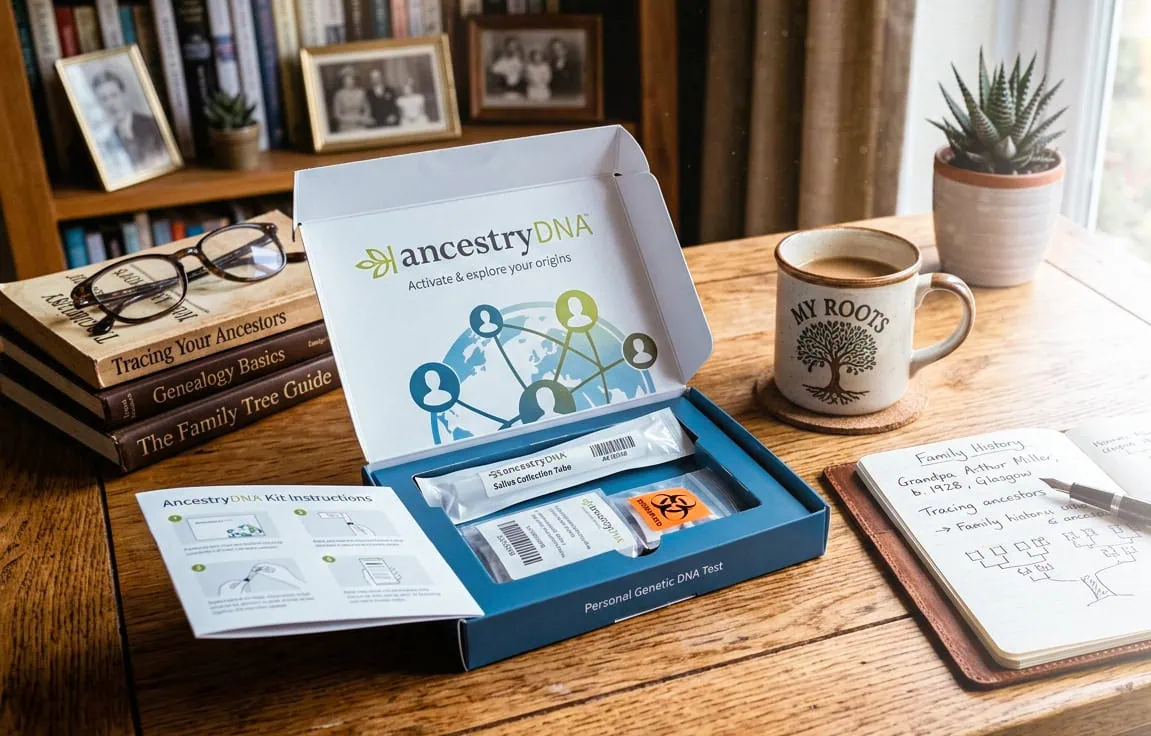
Testing companies offering autosomal DNA tests include: AncestryDNA, 23andMe, Family Tree DNA (Family Finder), MyHeritage DNA, and Living DNA.
X-DNA
X-DNA is included with some autosomal tests and does not require a separate kit. Because of its unique inheritance pattern, it can sometimes help you figure out which side of the family an unknown match comes from.
Key Terms to Know
- Centimorgan (cM): A unit of measurement for DNA. The more centimorgans you share with a match, the more closely related you likely are.
- Chromosome: A molecular package that carries DNA in cells.
- Haplogroup: A group of people who share a common ancestor and a particular genetic signature, used to identify deep ancestry and population history.
- Match: When two people’s DNA results suggest they likely share a common ancestor within a genealogically relevant timeframe.
- Most Recent Common Ancestor (MRCA): The most recent ancestor from whom a group of people share descent.
- Recombination: The process during which chromosomes from each parent swap segments before being passed to a child; one reason siblings don’t inherit identical DNA.
- Single-Nucleotide Polymorphism (SNP): Pronounced “snip,” a specific type of genetic variant used in DNA testing.
- Segment: A section of contiguous SNPs. A matching segment is a section that is the same between two people.
Which Testing Company Should You Choose?
A few questions can help narrow this down:
What are you trying to find out? If you want Y-DNA or mtDNA testing, Family Tree DNA is your only option. For autosomal testing to find cousins and build your tree, you have more choices. If your ancestry is predominantly Eastern European, MyHeritage is worth considering, as its database tends to have stronger representation in that region than some other major companies.
Do you already have a subscription? If you’re an Ancestry subscriber, testing with AncestryDNA gives you the advantage of matching against their enormous user database alongside the records you’re already searching. MyHeritage and Findmypast subscribers may similarly prefer to test on their respective platforms; Findmypast partners with Living DNA.
How comfortable are you working with DNA? AncestryDNA has the largest database and the most beginner-friendly interface, which makes it a solid first choice for most people. Family Tree DNA offers more tools for intermediate and advanced users.
A Note on 23andMe
23andMe filed for Chapter 11 bankruptcy in March 2025. Following a contested bankruptcy auction, the company’s assets — including its database of over 15 million customers’ genetic information — were acquired in July 2025 by TTAM Research Institute, a nonprofit public benefit corporation founded by 23andMe co-founder Anne Wojcicki. The service continues to operate under TTAM’s ownership, but the bankruptcy and the handling of customer DNA data have raised privacy concerns among genealogists, researchers, and state attorneys general across the country. If you’re considering testing with 23andMe, it’s worth staying up to date on developments and understanding your data deletion options.
Fish in More Ponds
Here’s a strategy worth knowing: you don’t have to test at every company to get matches. You can test at one company and then upload your raw DNA data to others.
- Family Tree DNA: Upload is free; unlock all features for a one-time fee of $19.
- Living DNA: Accepts uploads with limited free features.
- GEDmatch: A third-party site (not a testing company) where you can upload raw data from any company to find matches across all databases in one place. Basic tools are free; a Tier 1 subscription unlocks advanced tools. (Note: GEDmatch was acquired in 2019 by Verogen, a forensic genomics company. See the Law Enforcement section below for what that means for your privacy settings there.)
Neither AncestryDNA nor 23andMe accepts uploads from other companies. MyHeritage discontinued uploads in August 2025. If you want your genetic data to be in those databases, you will need to test there directly. The general advice in the genetic genealogy community is to test where you have the best reason to test first, then expand your reach by uploading to other databases.

Who Should You Test?
For most people, the instinct is to test themselves, and that’s a fine place to start. But you’ll want to think strategically, especially about the oldest generations in your family.
- Test the oldest generations first. Grandparents, parents, great-aunts and great-uncles — these are your most valuable test subjects. Because DNA is randomly shuffled with each generation, you and your siblings each inherited only a portion of your parents’ and grandparents’ DNA, which means some segments from further back may not have reached you at all. Once these family members are gone, that opportunity is gone too.
- Your siblings each inherited a different random 50% from your parents, so they may have matches you don’t.
- More distant cousins can be useful for confirming shared ancestry or filling in lines you don’t have access to through closer family.
Privacy, Law Enforcement, and Ethical Considerations
Privacy
None of the major DNA testing companies sells your information to third parties. Your results are also protected under the Genetic Information Nondiscrimination Act (GINA), a federal law passed in 2008 that prohibits certain forms of genetic discrimination. California law extends those protections further.
That said — as the 23andMe bankruptcy made very clear — your data can become complicated to protect when a company’s financial situation changes. It’s worth reading each company’s privacy policy and understanding your data deletion options before you test.
Law Enforcement
You may be wondering why law enforcement would have any interest in a genealogy database at all. The short answer is Investigative Genetic Genealogy (IGG), a technique in which law enforcement uploads DNA from an unidentified suspect in a violent crime (collected at a crime scene, for example) and searches a genealogy database for partial matches. Those matches aren’t the suspect themselves, but relatives who have tested. Investigators then build out family trees from those matches to try to identify the unknown person.
IGG is a powerful tool that has helped solve cold cases, including the 2018 identification of the Golden State Killer. Importantly, IGG is only supposed to be used for violent crimes such as murder and rape (particularly cold cases), and it is not intended as a tool for investigating lesser offenses. But it also means that by uploading your DNA to a genealogy database, you could potentially help identify a relative you didn’t know was a suspect — whether you intended to or not.
Each company handles law enforcement access differently:
- AncestryDNA — requires a court order
- 23andMe — requires a court order
- MyHeritage — requires a court order
- Living DNA — only if legally compelled to do so
- Family Tree DNA — New kits are now automatically opted out of IGG participation. (This was previously opt-in, which was a significant concern when it was first announced.)
Ethical Considerations
Before you test, or before you ask an elderly relative to test, it’s worth having a candid conversation about one particular possibility: finding something unexpected.
Genetic genealogy occasionally reveals surprises, such as misattributed parentage (sometimes called a “non-paternal event” or NPE). These discoveries can be profoundly meaningful for some people and deeply unsettling for others. There’s no right answer about whether to pursue or share this kind of information, but thinking through your own feelings in advance is wise.
A few specific things to consider when testing elderly relatives:
- They may have privacy concerns or “family secrets” that are unknown to the current generation.
- Some may have difficulty producing enough saliva for a spit-based test kit. (A cheek swab test, such as those offered by Family Tree DNA, may be easier.)
Genetic Genealogy
Where to Learn More
Wrap Up
DNA testing for genealogy can feel overwhelming at first, but you don’t have to understand everything before you get started. Choose a test that fits your goals, and give yourself time to learn. The genetic genealogy community is welcoming and full of people who love to help newcomers find their footing.
Have questions about getting started? Drop them in the comments!


This post contains affiliate links. I may receive a small commission if you choose to make a purchase, but it does not add anything extra to the price you pay. For more, please read my full Disclosure Statement. I appreciate your support!






My hubby and I retested at MyHeritage this year because of its upgraded whole genome sequencing (and the low sale price). The results were slightly more granular for hubby’s origins, giving me a fresh clue for research direction.
I just got a new MyHeritage kit in the mail so I can take advantage of whole-genome sequencing (and yes, the crazy low sale price). I’m not expecting any major breakthroughs, but one can hope, right? 😊🤞🏻
This is how I found my biological grandfather. You did a lot of research and work on this beautifully written blog post.
Thank you so much, Gwen. I hope finding your biological grandfather has brought you peace and happiness. 💕
Great beginner guide, Elizabeth. You covered so much, and I’m sure it will help many newbies out there looking for guidance. 🙂
Thank you, Diane!