Genetic Genealogy Resources for Beginners
Heart of the Family is a participant in the Amazon Services LLC Associate Programs and other affiliate services. This means that thefamilyheart.com receives a small commission by linking to Amazon.com and other sites at no cost to the readers.
Updated April 2026
The first time I opened my DNA results, I just sat there staring at the screen.
There was a long list of matches I didn’t recognize, ethnicity percentages that raised more questions than they answered, and a help center that seemed to assume I already knew what a centiMorgan was. I’m a board-certified genealogist now, but I still remember that moment of “…so what does any of this actually mean?”
If that sounds familiar, you’re in good company. Maybe you’re staring at thousands of matches and wondering now what? Maybe an ethnicity estimate doesn’t match the tree you’ve spent years building. Maybe a close match has surfaced that nobody can explain — or maybe you’re still holding an unopened test kit, not sure where to begin.
Wherever you are on the journey, the biggest hurdle isn’t the science. It’s knowing which resources to trust. The Board for Certification of Genealogists (BCG) has said we must “at least consider genetic genealogy as part of our reasonably exhaustive research,” and they’ve included standards to address it. That’s the bar every serious family historian is working toward, and the resources below are the ones I recommend to get you there.
I first published this guide in 2020, and a lot has changed since then: new tools, retired resources, and at least one testing company in and out of bankruptcy. Consider this the 2026 refresh, with everything re-verified and new favorites added.
I’ve organized them by format — books, webinars, YouTube, websites, tools, and community — so you can start with whatever suits your learning style best. Skim, skip around, or work through them in order. This isn’t a textbook, and there’s no test at the end. (Well. Other than the one you already took.)
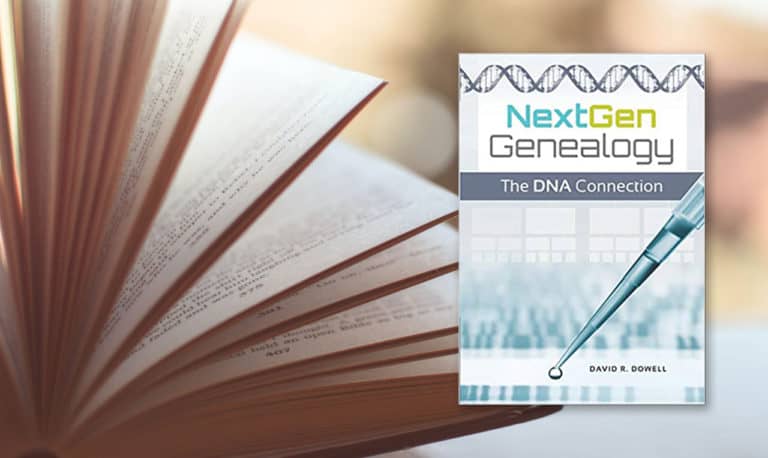
Books About Genetic Genealogy
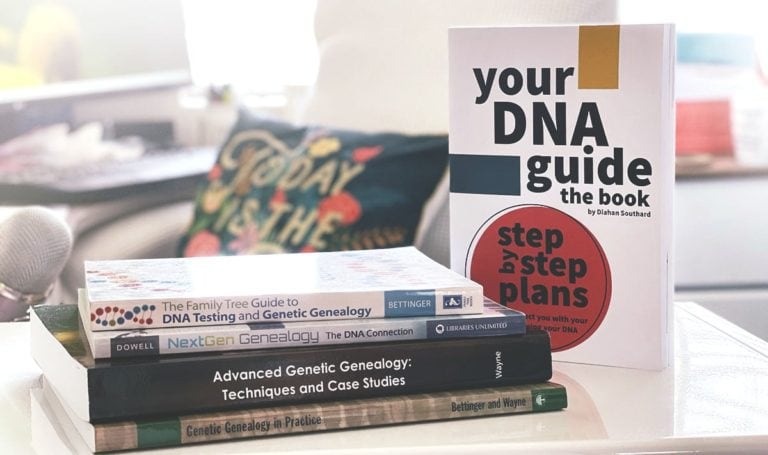
The Family Tree Guide to DNA Testing and Genetic Genealogy
By Blaine T. Bettinger
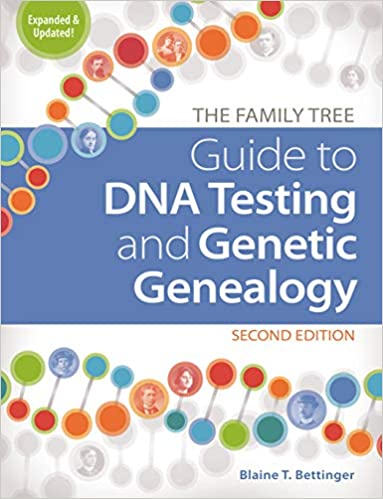
Description: Discover the answers to your family history mysteries using the most cutting-edge tool available. This plain English guide (newly updated and expanded to include the latest DNA developments) will teach you what DNA tests are available; the pros and cons of the major testing companies; and how to choose the right test to answer your specific genealogy questions. And once you’ve taken a DNA test, this guide will help you make sense of your often-overwhelming results, with tips for understanding ethnicity estimates, navigating suggested cousin matches, and using third-party tools like GEDmatch to further analyze your data. Get this book.
DNA Q and A: Real Questions from Real People about Genetic Genealogy
By Andrew Lee and Devon Noel Lee
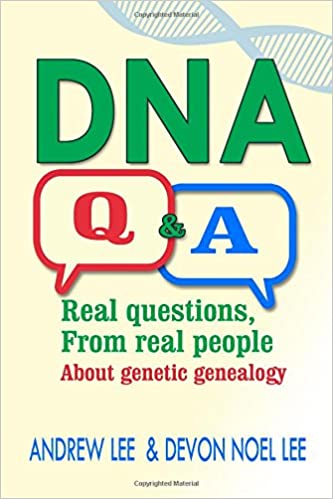
Description: Genetic genealogy generates compelling questions as people around the world attempt to understand haplogroups, ethnicity, and genetic matches. DNA Q&A has curated actual questions from real people who’ve sought to better understand DNA via the Family History Fanatics YouTube channel, eConferences, and live presentations. Is your question, or something similar, in the book? Find out the answer to it and more! Get this book.
Research Like a Pro with DNA
By Diana Elder, AG® and Nicole Dyer
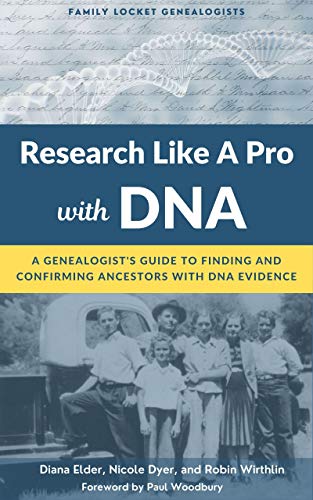
Description: Research Like a Pro with DNA is a step-by-step guide that walks you through the entire DNA research process – from creating a focused research objective to correlating DNA evidence with documentary sources and writing up your conclusions. If you’ve taken a DNA test and felt overwhelmed by the results, this methodology-forward book will help you turn your matches into meaningful discoveries that meet the Genealogical Proof Standard. It’s an excellent next step after you’ve read an introductory book and are ready to put DNA to work in your research. Get this book.
Your DNA Guide – the Book
By Diahan Southard
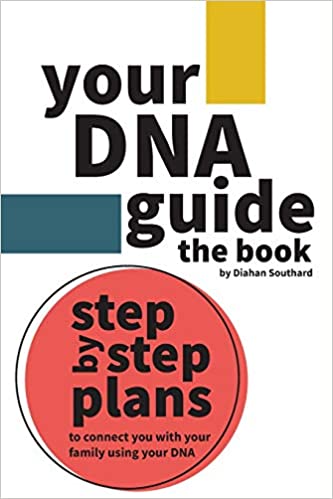
Description: You don’t have to learn everything about genetic genealogy before asking (and answering!) specific DNA questions. That’s the premise of Your DNA Guide – the Book, a unique approach to learning genetic genealogy. Instead of learning more than you need to know in textbook style, you’ll choose a specific DNA question and start exploring it right away. Follow concrete step-by-step plans, learning important DNA concepts – in plain English – as you go. As you proceed, you will check your progress and be guided based on your specific results at each stage. Get this book and the companion workbook.

Webinars
Legacy Family Tree Webinars
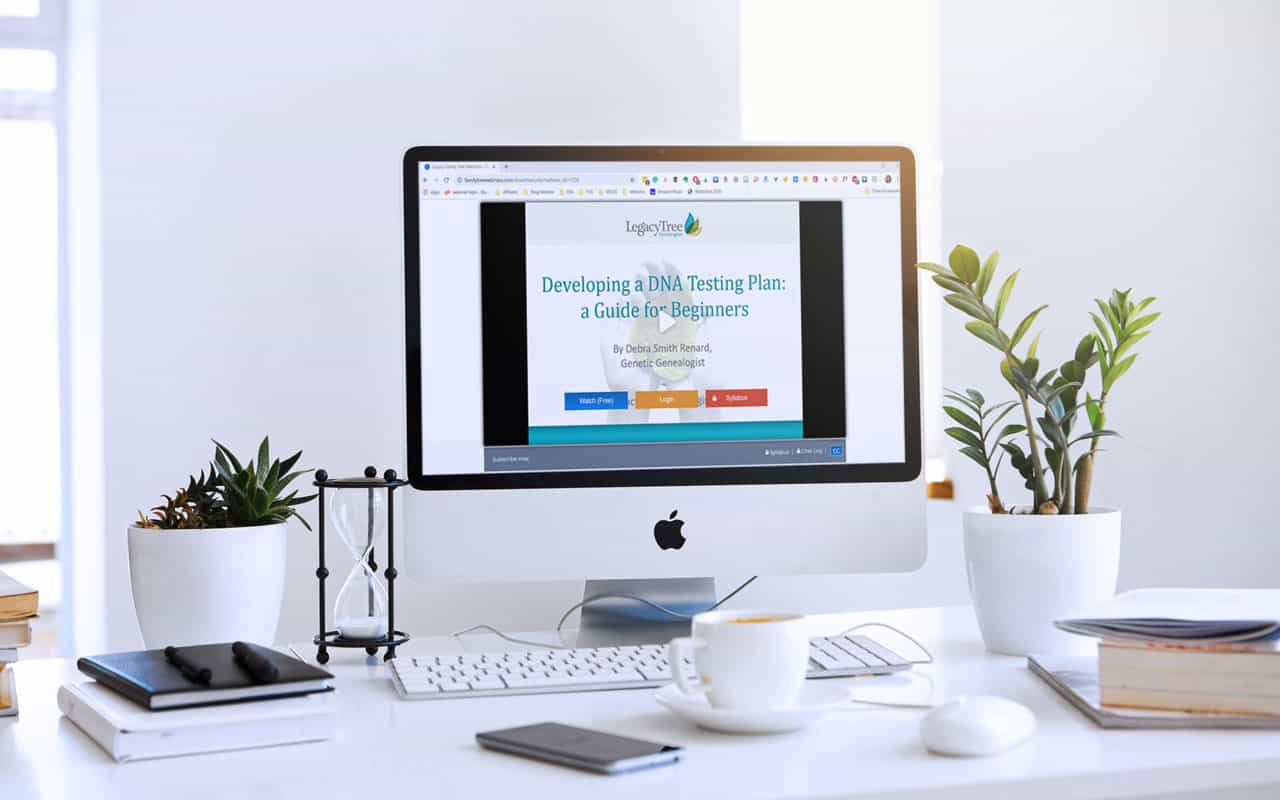
Foundations in DNA by Blaine T. Bettinger, Ph.D., J.D. — a freshly re-recorded 5-part series (2025) that’s the gold-standard starting point.
- Part 1 – Introduction to DNA and Genetic Genealogy
- Part 2 – Understanding and Using Y-DNA and mtDNA
- Part 3 – Understanding Autosomal DNA
- Part 4 – Using Shared Matching
- Part 5 – Ethnicity Estimates
Organizing Your DNA Results (2025 Update) by Diahan Southard — if you’ve already tested and are drowning in matches, this is the one. Diahan walks through color-coding, labeling, and filter-based organization for Ancestry and MyHeritage.
DNA in Action by Karen Stanbary, CG®, CGG® — a 2026 series on blending DNA with documentary evidence to meet the Genealogical Proof Standard. The ideal next step once you’re comfortable with the basics.
Check out the complete list of DNA webinars at Legacy Family Tree Webinars (includes prerecorded and upcoming live webinars). There are currently more than 170 webinars about DNA available to watch!

YouTube
Ancestry
Description: Bringing together science and self-discovery, Ancestry helps everyone, everywhere discover the story of what led to them. Their channel now includes a dedicated “DNA for Beginners” playlist featuring tips and strategies from Ancestry’s own genealogy experts. LINK
Family History Fanatics
Description: Teaching you how to climb your family tree while having fun along the way. Featuring videos about beginning genealogy, DNA tests and ethnicity results, RootsTech and other genealogy conferences, preservation, and sharing family history. LINK
Family Tree DNA
Description: Family Tree DNA is the world leader in Y chromosome, autosomal, and mitochondrial ancestry DNA testing for genetic genealogists. Learn how their tests can help you. LINK
MyHeritage
Description: MyHeritage is the leading global discovery platform for exploring family history, uncovering ethnic origins, finding new relatives, and gaining valuable health insights. With sophisticated matching technologies and billions of international historical records, MyHeritage empowers users to build their family trees and make exciting family connections. As the world’s only integrated service that combines family history and DNA testing for genealogy and health, MyHeritage is uniquely positioned to offer users a meaningful discovery experience that unites their past, present, and future. LINK

Websites & Blogs
- International Society of Genetic Genealogy (ISOGG) Beginner’s Guides to Genetic Genealogy – You won’t find a more comprehensive list of resources than this one!
- Family Tree DNA Glossary of Terms – A thorough, alphabetized glossary that demystifies the jargon you’ll encounter as you dig into your results — everything from “allele” and “autosomal” to “haplogroup” and “triangulation.”
- DNAeXplained (Roberta Estes) – One of the most respected genetic genealogy blogs on the internet. Roberta writes frequently, thoroughly, and accessibly on everything from beginner basics to the latest vendor updates.
- The DNA Geek (Leah Larkin) – Leah has a Ph.D. in biology and brings a scientist’s rigor to genetic genealogy topics. Her writing is especially helpful for understanding the why behind DNA test results. She also publishes at thednageek.substack.com.
- Kelly Wheaton’s Beginner’s Guide to Genetic Genealogy – A series of 16 easy-to-understand, self-guided lessons, updated through 2020. (Note: This guide moved from its original Google Sites home to wheatonwood.com – be sure to update any bookmarks!)
- Cyndi’s List of DNA, Genetics & Family Health Resources
- Cyndi’s List of DNA, Genetics & Family Health blogs
- ISOGG’s list of genetic genealogy blogs
Tools
The genetic genealogy landscape has exploded with useful free and low-cost tools in recent years. Here are two tools every beginner should know about:
DNA Painter
DNA Painter is a collection of free and premium tools that have quickly become essential for genetic genealogists. Even as a complete beginner, you’ll want to bookmark two features right away:
- The Shared cM Tool – Enter the number of centiMorgans (cM) you share with a DNA match, and this tool will show you the most likely relationships that could account for that amount of shared DNA. It’s the fastest way to make sense of a new match.
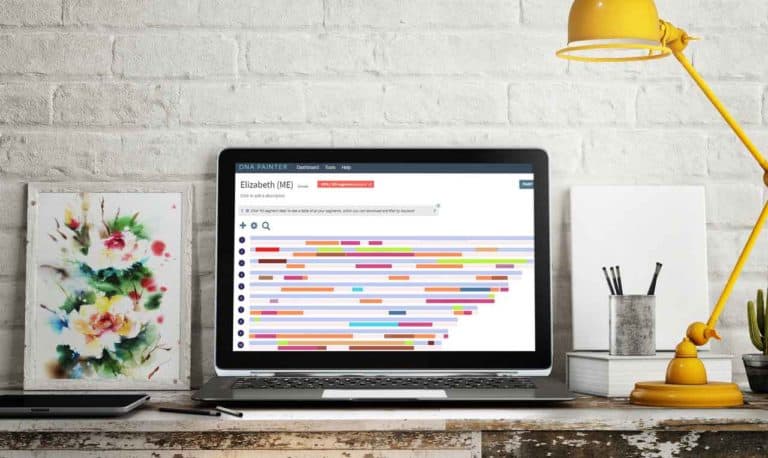
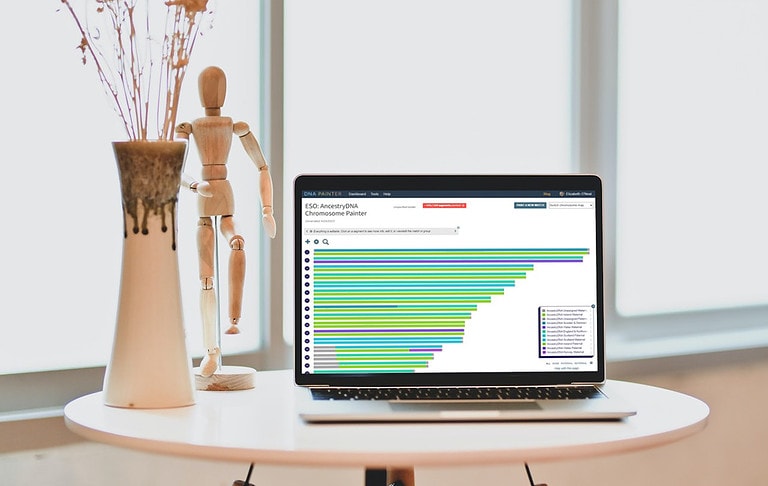
- Chromosome Mapping – As you grow more confident, you can use DNA Painter to visualize which segments of DNA came from which ancestors.
GEDmatch
GEDmatch is a free third-party site where you can upload your raw DNA data from Ancestry, 23andMe, MyHeritage, or Family Tree DNA to find matches with people who tested at a different company. It also offers powerful analysis tools not available at the major testing companies. Be sure to read the Terms of Service carefully and choose your matching preferences thoughtfully before uploading.
Want to Learn More About Tools?
If you want a closer look at the tools I use most, check out my post 4 Genetic Genealogy Tools I Use All the Time.
Facebook Groups
Genetic Genealogy Tips & Techniques
Description: Genetic Genealogy Tips & Techniques is a place to discuss topics in DNA, ranging from beginner to advanced.
DNA Newbie
Description: This is a Facebook group for those wishing to learn how DNA testing can help with genealogical research. Discussion topics & queries must be relevant to genealogical uses of DNA testing. Medical uses of DNA testing are off-topic for this group.
Wrap Up
You don’t have to read every book, watch every webinar, or subscribe to every blog on this page. That would just be a different kind of overwhelm. Pick the one resource that matches where you are right now — one book if you’d like to read, one webinar if you learn by watching, one tool if you’re ready to dig into your matches — and start there. Everything else will still be here when you need it.
What are your favorite resources for learning about genetic genealogy? Do you have any tips you can share to help other beginners? Please share in the comments!


This post contains affiliate links. I may receive a small commission if you choose to make a purchase, but it does not add anything extra to the price you pay. For more, please read my full Disclosure Statement. I appreciate your support!

This is a great Post and exactly what I need. I’m very much at beginner standard for DNA. I’ve registered for the Legacy DNA webinar. Will also check out your suggestions #geneabloggers Sharing
Thanks, Jennifer! Glad you found the post to be helpful!
Thank you Elizabeth for providing such a wealth of information….?
You’re quite welcome, Ancestor Detective!
Wow, you’ve done a lot of work vetting all the resources out there. I’ll definitely bookmark this post.
Glad you found it helpful, Laura! 😀
When I was first figuring this out I watched numerous webinars, often more than once, and Roberta Estes blog, DNAeXplained, was invaluable. To keep up-to-date, I’m attending the GGI conferences this year – one last weekend in Belfast, and a second later this year in Dublin.
Roberta’s blog is amazing, isn’t it, Dara?! She’s helped me a lot, too. The GGI conferences sound awesome! I’d love to hear more about them. 🙂
Another excellent blog about genealogy resources — one that will surely be appreciated by DNA beginners.
Thank you, Molly!