Understanding Your DNA Ethnicity Estimates: What They Tell You (And What They Don’t)
Heart of the Family is a participant in the Amazon Services LLC Associate Programs and other affiliate services. This means that thefamilyheart.com receives a small commission by linking to Amazon.com and other sites at no cost to the readers.
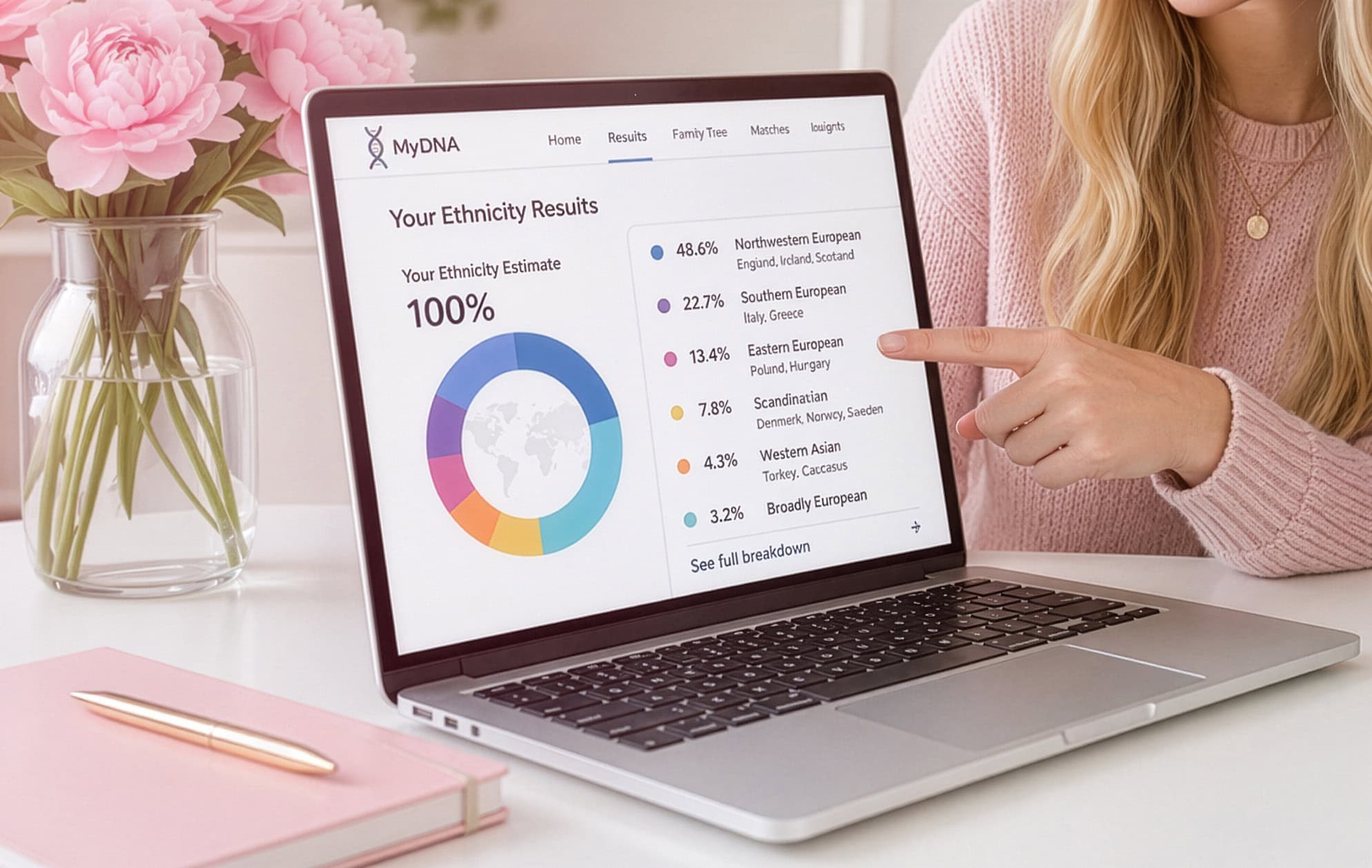
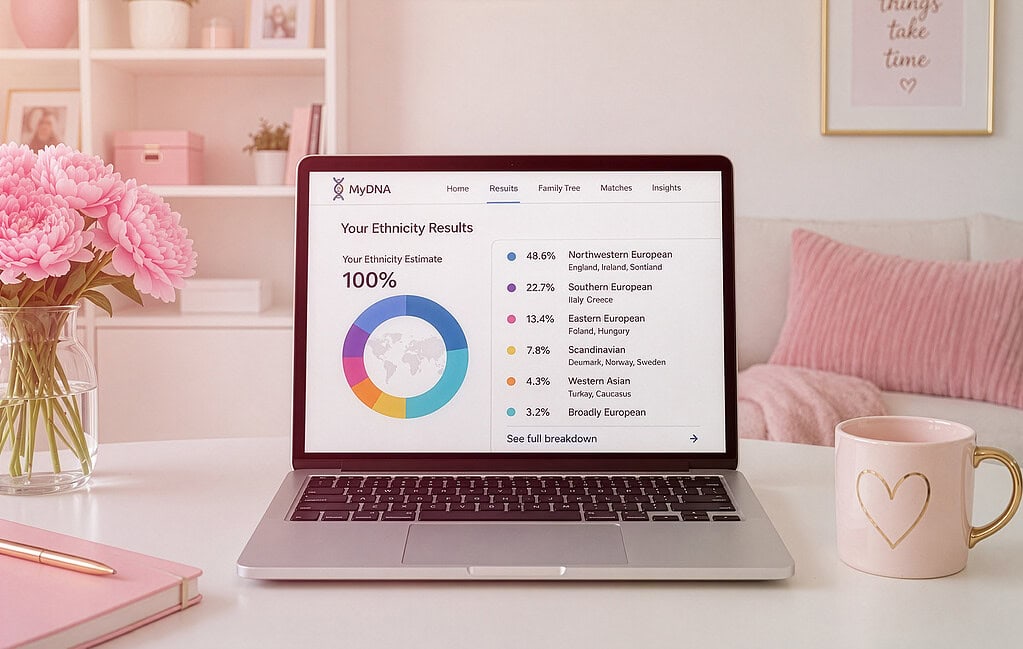
You’ve taken a DNA test, eagerly opened your results, and there it is: a colorful pie chart or map breaking down your heritage into tidy percentages. Maybe you’re 42% English, 28% Irish, 15% German, and a smattering of other regions. It feels precise. It feels definitive.
But is it?
Ethnicity estimates are among the most exciting yet most misunderstood features of consumer DNA testing. People tend to read those percentages as hard facts, like a blood test or a paternity result. But ethnicity estimates are statistical predictions, not measurements. They depend on which populations the testing company has sampled, how their algorithm interprets your DNA, and how they’ve chosen to label each region. All of that can (and does) change over time, which is why your results may shift from one update to the next.
As you explore this topic, you might also see ethnicity estimates referred to as “admixture” results, especially in more technical discussions or on third-party tools like GEDmatch. “Admixture” is simply a scientific term for the mixing of different ancestral populations over time. It refers to the same colorful breakdown of your heritage into regional percentages. If you come across either term, know that they’re describing the same analysis.
As a board-certified genealogist who regularly works with DNA results, I want to walk you through what’s actually happening behind those percentages and how to use them wisely in your research.
How Ethnicity Estimates Work
When a genetic genealogy testing company like AncestryDNA, Family Tree DNA, or MyHeritage analyzes your DNA, they’re comparing your results against reference panels: curated groups of people whose ancestry from a specific region has been documented for multiple generations. The algorithm looks at segments of your DNA and asks, “Which reference population does this segment most closely resemble?”
The keyword there is resemble. Your DNA isn’t being matched to a country or a culture. It’s being compared to a modern-day sample of people, and the algorithm is making its best statistical guess.
Why Your Results Change
If you’ve noticed your ethnicity estimates shifting over time, you aren’t imagining things. Testing companies regularly update their reference panels and refine their algorithms. A region that once showed up at 12% might disappear entirely in the next update, or a new region you’ve never seen before might appear.
This doesn’t mean your DNA changed. It means the testing company got better data or improved its methods. Think of it like a weather forecast that becomes more accurate as the models improve. The underlying reality (your DNA) stays the same, but the interpretation evolves.
What Ethnicity Estimates Can’t Tell You
There are some important limitations to keep in mind:
Ethnicity estimates do not reflect culture, nationality, or identity. DNA doesn’t carry passports. Borders have shifted throughout history, and populations have migrated, mixed, and resettled for millennia. A high percentage of “English” DNA doesn’t necessarily mean your ancestors identified as English; it means your DNA resembles the DNA of people living in England today.
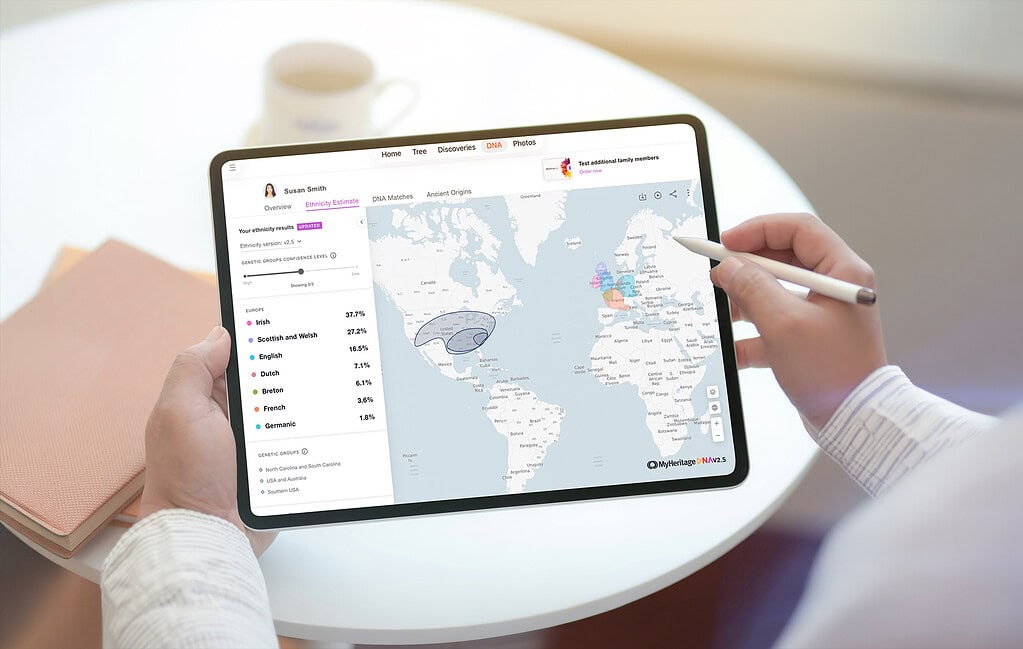
They struggle with closely related populations. Distinguishing between English, Irish, Scottish, and Welsh ancestry is notoriously difficult because these populations share deep genetic roots. The same is true for many neighboring regions worldwide. If your results swing between Scandinavian and British, it may simply reflect the genetic overlap left behind by centuries of Viking settlement.
They become less reliable further back in time. Ethnicity estimates are most useful for reflecting your ancestry over roughly the last 500 years or so. Beyond that, the randomness of genetic inheritance means that large portions of your deep ancestry simply aren’t represented in your DNA anymore.
Percentages are estimates, not measurements. The confidence intervals on these numbers are often much wider than people realize. That 28% Irish might actually fall within a range of 15% to 40%. The precise number gives a false sense of, well… precision.
Results can vary wildly from company to company. This is one of the biggest sources of confusion for people who test with more than one service. You might be 35% Scandinavian on AncestryDNA and only 8% on 23andMe, or show significant Italian ancestry on one platform but none at all on another. That doesn’t mean one company is right and the other is wrong.
Each company uses its own reference panels, its own algorithms, and its own way of defining and labeling population groups. In other words, they’re interpreting the same DNA through different lenses. The result is that you may get noticeably different breakdowns depending on where you test. If you see major discrepancies, resist the urge to pick the result you like best. Instead, look for the broader patterns that show up consistently across platforms.
What Ethnicity Estimates Can Tell You
Despite the caveats, ethnicity estimates aren’t useless. They can point you toward regions and populations you might not have considered. If you see an unexpected percentage — say, a chunk of Southern European ancestry when your known family tree is entirely Northern European — that’s worth investigating. It could reveal an adoption, a family secret, or simply an ancestor you haven’t discovered yet.
Ethnicity estimates are also useful as a “broad-strokes” confirmation of what you already know from your paper trail. If your documented research shows deep roots in Scandinavia and your DNA results agree, that’s a reassuring signal that your documentary genealogical work is on track.
Tips for Making the Most of Your Estimates
Compare across companies, but look for agreement. As I mentioned above, different companies will give you different numbers. Rather than fixating on the discrepancies, pay attention to the regions that appear consistently. If three out of four platforms show a meaningful amount of West African ancestry, that’s a strong signal worth pursuing in your research.
Focus on the big picture. Continental-level results (European, African, East Asian) are far more reliable than country-level breakdowns. If your results say you’re 50% European, that’s a strong signal. If they say you’re exactly 23% French, hold that number loosely.
Use them as clues, not conclusions. Ethnicity estimates are a starting point for research questions, not the final answer. Pair them with your match list, shared segment data, and good old-fashioned genealogical records for the fullest picture.
Track your updates. When your testing company releases a new estimate, take a screenshot or note the changes. Over time, the pattern of revisions can itself be informative about which parts of your ancestry the science is most confident about.
Genetic Genealogy
Where to Learn More
Wrap Up
Ethnicity estimates are a fascinating and evolving tool in the genetic genealogist’s toolkit. They can inspire new research directions, validate existing work, and occasionally deliver a genuine surprise. But they work best when you understand them for what they are: educated guesses based on the best available science, not a definitive map of who you are.
Your identity is so much richer than a pie chart. The real magic happens when you combine your DNA results with records, stories, and the kind of deep research that brings your ancestors to life as real people, not just percentages on a screen.


This post contains affiliate links. I may receive a small commission if you choose to make a purchase, but it does not add anything extra to the price you pay. For more, please read my full Disclosure Statement. I appreciate your support!