
Where Did She Go? Why Women Disappear in the Records After Marriage
Heart of the Family is a participant in the Amazon Services LLC Associate Programs and other affiliate services. This means that thefamilyheart.com receives a small commission by linking to Amazon.com and other sites at no cost to the readers.
If you’ve been researching your family history for any length of time, you’ve probably had this experience: you find a woman in her parents’ household — perhaps in a census record as a child or young adult — and then she vanishes. No obvious marriage record. No clear trail forward. No sign of her under the name you know.
It can feel like she simply disappears from the historical record.
But she didn’t disappear. The records just stopped calling her by the name you’re searching for… and in many cases, they stopped recording her as an independent individual at all.

A Note on Scope: This post focuses primarily on women researched in the United States, roughly from the colonial era through the early twentieth century. Coverture and its effects on recordkeeping varied significantly by jurisdiction, time period, and record type. Researchers working in other countries or outside this timeframe will find that some details differ, though many of the underlying principles apply broadly.
The Legal Architecture of Invisibility
Under the doctrine of coverture, a married woman’s legal identity was, in many jurisdictions, subsumed under that of her husband. While the specifics varied by time and place, the practical effect for genealogists is consistent: a woman may no longer appear as an independent legal actor.
Her name may be absent from transactions her husband conducted on her behalf. She may be referenced only in relation to him — as a wife releasing dower rights, as a beneficiary described as “daughter of…” or “heirs of…”, or simply as “Mrs. John Smith,” with no given name recorded at all.
So the issue is not simply that her name changed. It’s that the way she was recorded changed. In some record types, she may seem to disappear entirely.
COVERTURE
The condition or state of a married woman. Sometimes used elliptically to describe the legal disability arising from a state of coverture.1Henry Campbell Black, A Dictionary of Law: Containing Definitions of the Terms and Phrases of American and English Jurisprudence, Ancient and Modern; Including the Principal Terms of International, Constitutional, and Commercial Law; with a Collection of Legal Maxims and Numerous Select Titles from the Civil Law and Other Foreign Systems (St. Paul, Minnesota: West Publishing Co., 1891), 298.
The Illusion of Disappearance
From a research perspective, this creates a kind of documentary illusion. Before marriage, a woman may appear clearly and consistently: in census records with her parents, in church registers, in local community records. After marriage, she may still be present in the historical record, but under a different surname, in a different household, and with reduced visibility across certain record types.
This shift can make it seem as though one person disappears and another, unrelated person appears in her place. In reality, you are often looking at the same individual recorded under different names and in different contexts.
The research problem, then, is not that she is absent. It’s that she is harder to recognize.
Where She Does Appear: Reading the Records More Closely
Once you begin looking beyond names alone, women become considerably more visible.
- Census records, when read carefully, offer age, birthplace, and household structure, all of which can support identification even without a surname match.
- Marriage records, when they survive, are the most direct evidence.
- Probate records frequently name women as daughters, widows, or heirs. Land records — particularly dower releases or jointly executed deeds — can reveal a married woman’s presence in transactions that might otherwise appear to belong solely to her husband.
- Church records, including the baptismal entries of her children, can significantly extend a research trail.
- Newspaper notices of marriages, deaths, and even social items round out the picture.
In many cases, no single record will explicitly identify her. Instead, identification emerges through correlation across multiple sources… which is where the real work begins.
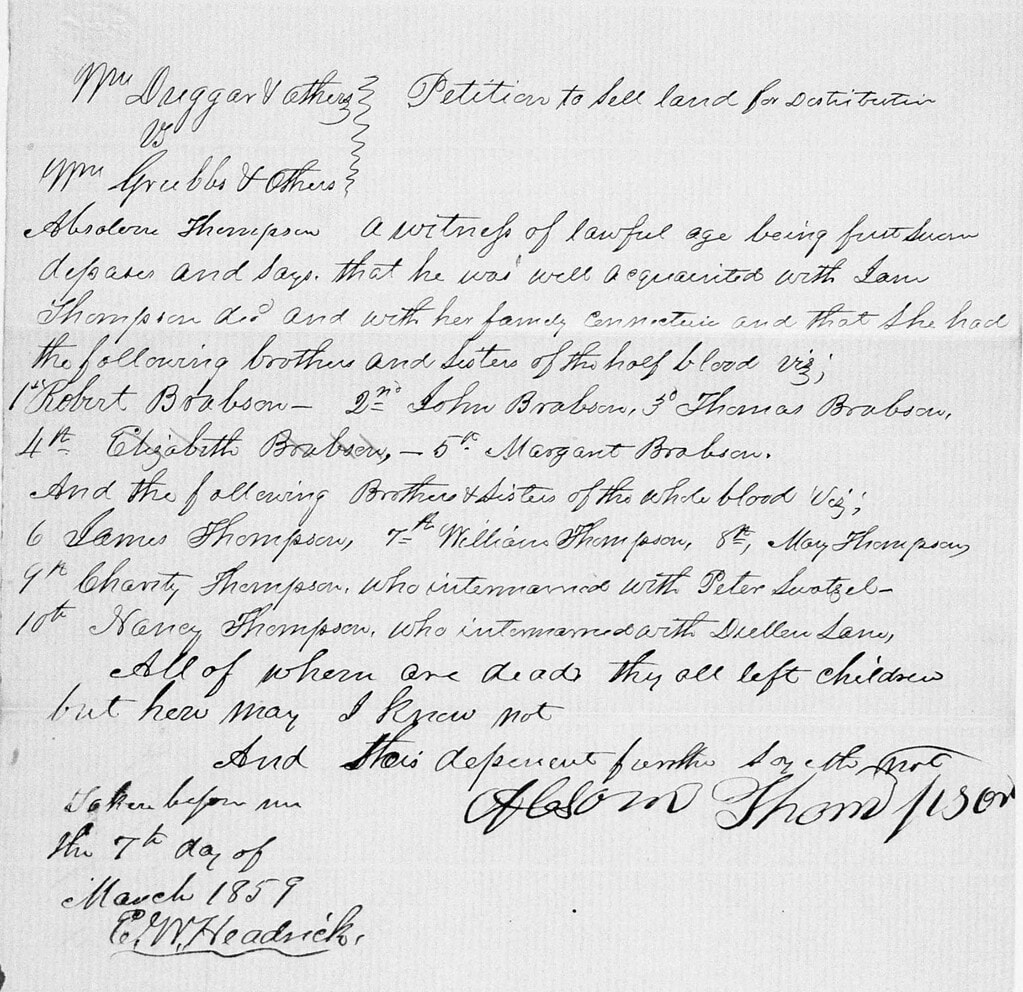
Greene County, Tennessee, Court Records. Image from FamilySearch.
Reconstructing Identity: A Methodological Approach
When a woman seems to disappear, the goal is not simply to find a record bearing her name. It is to reconstruct her identity across changing contexts. This requires a shift from name-based searching to evidence-based reasoning.
Consider a hypothetical example. Mary Jones appears in the 1850 census, age 22, living with her parents in a rural county in Ohio. By 1860, she was no longer in that household, and a search for a marriage record yields nothing.
But a deed recorded in the same county in 1853 shows a John and Mary Smith executing a sale of land that adjoins Mary’s father’s farm, and it includes a separate dower release signed by Mary Smith. The 1860 census shows a John Smith household with a wife named Mary, age 32, born in Ohio, and two young children. No single record names her as Mary Jones. But the convergence of age, birthplace, geography, and family connection builds a compelling case.
That kind of reconstruction follows a consistent methodological pattern:
- Establish a timeline before marriage. Document her last known appearance under her maiden name. This provides a geographic and chronological anchor for everything that follows.
- Search for marriages — but don’t stop there. A missing marriage record does not mean a marriage did not occur. Treat it as one piece of a larger puzzle, not the end of the search.
- Track the family forward. Follow parents, siblings, and extended kin. Women often remained connected to their family networks after marriage, and those connections frequently surface in the records.
- Analyze households, not just individuals. In census records, consider age consistency, birthplace patterns, and children’s names, which may reflect family naming traditions and point back to her origins.
- Apply the FAN Club principle. Friends, associates, and neighbors can provide critical clues. A familiar surname in the same neighborhood may indicate a marriage connection worth pursuing.
From Clues to Conclusions: Using Indirect Evidence
In many cases, you will never find a single record that states plainly: this woman is the daughter of X and the wife of Y. Instead, you will need to build a case from indirect evidence: a woman of the correct age and birthplace appearing near her parents, a land transaction connecting a couple to her family, a probate record naming heirs consistent with known relationships.
Individually, these pieces may be inconclusive. Together, and when evaluated against the full body of available evidence, they can support a well-reasoned conclusion. This is where genealogical research moves beyond searching into interpretation, and where the Genealogical Proof Standard provides the framework for assembling that evidence into a soundly reasoned, fully documented conclusion.2Board for Certification of Genealogists, Genealogy Standards, second edition revised (Nashville, Tennessee: Ancestry.com, 2021), 1.
A Final Thought
One of the most important shifts in genealogical thinking is this: women do not disappear from the records. They become more difficult to recognize within them.
Researching women well asks us to think in terms of relationships rather than individuals, to correlate evidence across multiple sources, and to remain open to indirect but compelling conclusions. It asks us to understand not just what the records say, but why they were created and who was — and wasn’t — expected to appear in them by name.
When we make that shift, something remarkable happens. The women we thought were lost come back into focus. Not because new records have appeared, but because we’ve learned to read the ones that were always there.


This post contains affiliate links. I may receive a small commission if you choose to make a purchase, but it does not add anything extra to the price you pay. For more, please read my full Disclosure Statement. I appreciate your support!
Footnotes
- 1Henry Campbell Black, A Dictionary of Law: Containing Definitions of the Terms and Phrases of American and English Jurisprudence, Ancient and Modern; Including the Principal Terms of International, Constitutional, and Commercial Law; with a Collection of Legal Maxims and Numerous Select Titles from the Civil Law and Other Foreign Systems (St. Paul, Minnesota: West Publishing Co., 1891), 298. ↩︎
- 2Board for Certification of Genealogists, Genealogy Standards, second edition revised (Nashville, Tennessee: Ancestry.com, 2021), 1. ↩︎