

Sanborn Fire Insurance Maps: A Guide for Genealogists
Heart of the Family is a participant in the Amazon Services LLC Associate Programs and other affiliate services. This means that thefamilyheart.com receives a small commission by linking to Amazon.com and other sites at no cost to the readers.
Updated April 2026
If you have ancestors who lived in a city or town between the late 1860s and the mid-twentieth century, there’s a good chance someone drew their neighborhood in extraordinary detail, right down to the thickness of the walls, the material of the roof, and the distance to the nearest fire hydrant. Those drawings are fire insurance maps, and they are one of the most underused resources in genealogical research.
Originally created for insurance underwriters who needed to assess the risk of insuring urban properties, fire insurance maps became, over time, a remarkably precise visual record of American cities and towns. For family historians, they answer questions that no census record or city directory can: What did the block look like? Was the dwelling a wood-frame house or a brick storefront? How close were the neighbors? What church, factory, or school stood at the end of the street?
This guide covers what fire insurance maps are, how to read and use them, and — most importantly — where to find them online, including a state-by-state list of freely accessible digital collections.
What are Fire Insurance Maps (and What are Sanborn Maps)?
Fire insurance maps are an incredible source of detailed historical information about cities, towns, and urban areas. They were originally produced to provide insurance underwriters with a catalog of information used to assess the risk of insuring a particular property.
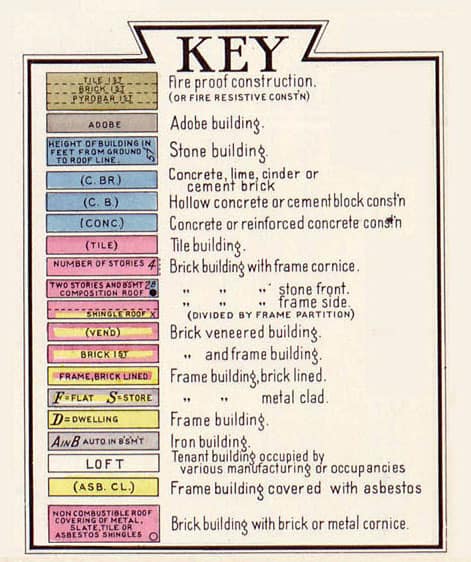
For each property, a colorful key was used to show a property’s address and lot lines, what it was used for (i.e., dwelling, hotel, church, business, etc.), what the building was constructed from and whether or not it was “fire-resistive,” its height and number of stories, the thickness of walls, special features such as doors, windows, chimneys, garages, stables, and elevators, as well as access to water from pipes, hydrants, cisterns, and more.
Several companies produced fire insurance maps, including the Dakin Publishing Co., G. M. Hopkins & Co., and the G. W. Baist Company. But by far the most prolific and well-known of these companies was the Sanborn Map Company. Founded in 1866 by Daniel Alfred Sanborn, the Sanborn Map Company surveyed and mapped 50 towns across the United States in its first year alone, and by 1873, just 7 years later, it had surveyed more than 600.1“Sanborn Map Company Inc.” Encyclopedia.com. 28 April 2020. https://www.encyclopedia.com/books/politics-and-business-magazines/sanborn-map-company-inc.
The Sanborn map collection consists of a uniform series of large-scale maps, dating from 1867 to the present. The Sanborn Map Company’s archives and map licenses are now held by LightBox, a real estate data services company, though the Sanborn brand continues as a geospatial division. Their archives contain over 1.2 million Sanborn maps containing the history of approximately 12,000 American cities and towns.
How to Use Fire Insurance Maps for Family History Research
Fire insurance maps are not only used by insurance underwriters. Over the years, others also found them useful: historians, geographers, urban planners, infectious disease specialists, and even genealogists.
We can learn a great deal about the area where our ancestors lived and worked by using fire insurance maps. Here’s how to get started using them in your family history research.
- Find out where your ancestor lived. Look for street addresses in the documents you’ve accumulated for your ancestors, such as city directories, passport applications, newspaper social columns, land records and deeds, WWI and WWI draft registrations, Social Security applications, and U.S. census records from 1880 going forward. Even death certificates often record the “usual residence” of the deceased.
- Look for fire insurance maps for that area. The Library of Congress has the majority of fire insurance maps, but many other libraries, universities, and historical societies also have copies. See the section below for tips on where to look for maps.
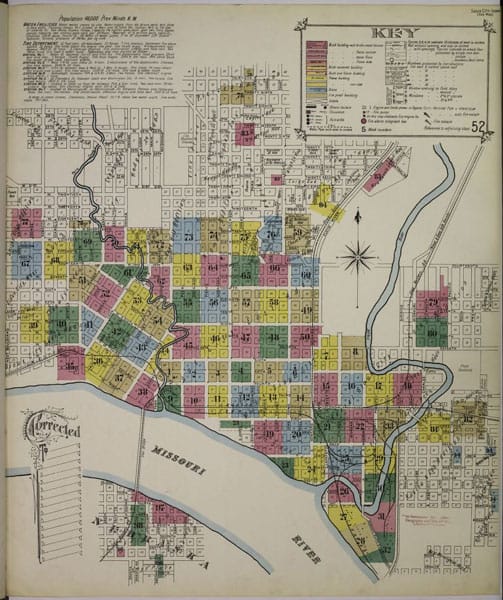
- Locate the map sheet for your ancestor’s address. Start by looking for the Index page, which is typically located at the back of the book.2The digital location may vary, depending on how the images were uploaded to the website where they are housed. Some websites place the Index and Key pages at the front of the deck rather than at the back. Find your ancestor’s street name to get the corresponding map page number. If you already know where your ancestor’s residence was located, you may be able to skip the Index and go straight to the Key page to get the map page number. Return to the image deck to find the exact map page with your ancestor’s street on it.
- Find the desired dwelling or building. Be sure to take a look at the Key to find out what kind of building it was, how it was constructed, and what fire safety measures it had, etc.
- Explore the neighborhood. What buildings are nearby? Is there a church? A school? How far away was your ancestor’s place of employment? Make a note of any buildings or features that you should investigate to help your research.
- Meet the neighbors. If you used a census record or city directory to find your ancestor’s address, you may also be able to find out who owned or lived in the dwellings nearby. This is your ancestor’s FAN Club (Friends, Associates, Neighbors), so you’ll want to find out who they were and how they may have interacted with your ancestor.
- Compare with future maps to see how the area evolved. Time and progress will have brought changes to your ancestor’s town. Follow their residence in additional fire insurance maps, if available. Take a look at Google Maps to see if your ancestor’s residence is still standing. Compare what you see to photos of your ancestor’s residence.
- Download, save, and/or print a copy of the map for future use. Don’t forget to record where you found the maps online so you can return to the site later if needed.
Where to Find Fire Insurance Maps
Fire insurance maps can be challenging to find. Below are the best places to start your search.
ProQuest
ProQuest’s collection of approximately 660,000 Sanborn maps remains one of the largest available and covers all fifty states and D.C. Access requires a library subscription, though some public and university libraries provide remote access with a library card.
Depending on your library’s subscription tier, you may have access to the standard database or the Geo Edition, which allows maps to be searched by street address and GPS coordinates — a significant improvement for researchers working with specific locations. Note that the maps in the standard ProQuest database are displayed in black and white, digitized from the original microfilm rather than from the color originals.
The Library of Congress
The Library of Congress website currently has more than 35,000 Sanborn maps from the United States, Canada, Mexico, and Cuba. All public-domain Sanborn maps have been fully digitized, except for some sheets from 1923–1930, which remain under copyright review.
The maps are arranged by state, then city, and release data. An advanced search feature can help narrow your search.
The LOC also now has a Sanborn Atlas Volume Finder, a GIS tool for large cities that lets you enter a street address and identifies which volume covers that location. This tool is useful for cities like New York, Chicago, and Philadelphia.
David Rumsey Maps
The David Rumsey Map Collection includes over 600 fire insurance maps from various locations in the United States and England. From the home page, search for the term “fire insurance” or click this link to go directly to the fire insurance maps.
Historic Map Works
Historic Map Works also has a decent collection of fire insurance maps. Unfortunately, there doesn’t seem to be an easy way to navigate them.
From the search page, search for the term “Sanborn,” then sort alphabetically to find your desired location. Alternatively, try doing a location search, and then scroll through the results for Sanborn Maps.
OldInsuranceMaps.net
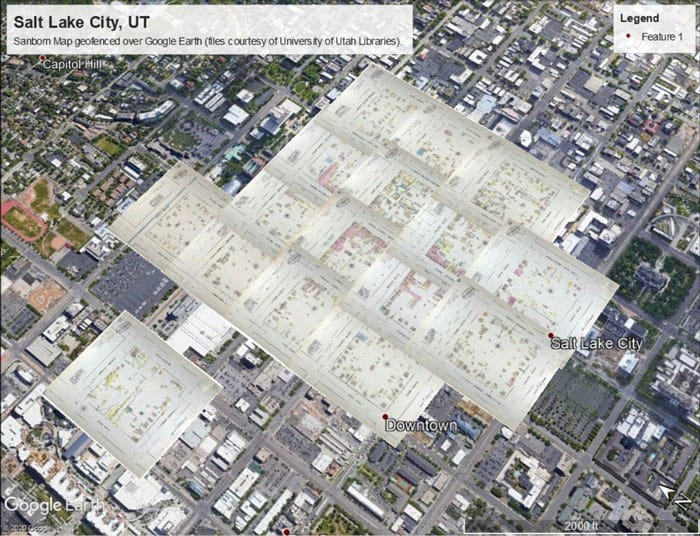
OldInsuranceMaps.net is a free, community-driven platform for creating and viewing georeferenced mosaics of Sanborn maps drawn from the Library of Congress collection. Users can browse georeferenced maps for over 1,200 map sets across 413 cities, overlaying them on modern basemaps for geographic context. The site is actively maintained, funded in part by the National Institutes of Health and academic partners, including the University of Michigan and the University of Richmond.
Libraries, Universities, and Other Organizations
Many libraries and universities host their own digital collections of fire insurance maps. Some of those can be accessed with a ProQuest subscription, while others are only available to patrons with a library card. Those collections are not listed here.
This list includes fire insurance map collections that are freely available to the public. The links are sorted by state.
Alabama
- A collection of 3,121 maps produced by the Alabama Inspection and Rating Bureau (AIRB) and the Sanborn Fire Insurance Company – The University of Alabama.
- Various AIRB maps for the years 1930–1969 – The Alabama Department of Archives and History
Arizona
- Index of Arizona Sanborn Maps – Arizona State University
- Sanborn Maps for Tucson, 1883, 1886, 1901, and 1909 – The Tucson Fire Department
California
- General Index to Sanborn Maps Los Angeles California, 1964 – The Los Angeles Public Library
- Sanborn Maps for San Francisco 1905, and G. W. Baist maps for Los Angeles, California, 1921 – David Rumsey Map Collection
- Sanborn Map for the Golden Gate International Exposition, 1940 – David Rumsey Map Collection
- Sanborn Maps for Mission Beach, California – Stanford University Libraries
- Black and white images of Sanborn Maps for San Francisco, 1899/1900 – San Francisco Genealogy
Colorado
- Index of Sanborn Maps of 79 principal cities in 52 counties, 1883–1922 – University of Colorado Boulder
- Same collection, unindexed maps – University of Colorado Boulder
Connecticut
- Connecticut Sanborn Fire Insurance Maps – Yale University Library
- New Haven Sanborn Finder – Yale Maps
- Black and white images of Sanborn Maps for the Mystic area, 1884–1939 – The Mystic Seaport Museum
Delaware
- Sanborn Maps for New Castle, 1885 – The New Castle, Delaware, Community History and Archaeology Program
District of Columbia
- G. M. Hopkins Real Estate Plat Books for the D.C. area, 1874–1896 – Dig DC
- G. W. Baist Real Estate Atlases for D.C., 1903–1919, Library of Congress
Florida
- Sanborn Maps of Florida, 1884–1923 – University of Florida Digital Collections
Georgia
- Sanborn Maps for various Georgia cities and towns, 1884–1941 – The Digital Library of Georgia
Hawai’i
- Dakin Fire Insurance Maps for Honolulu, 1891, 1899, and 1906 – The University of Hawai’i at Mānoa
- Sanborn Maps of Honolulu, 1914 – The University of Hawai’i at Mānoa
Illinois
- Sanborn Maps maps for various Illinois towns, pre–1923 – Illinois University Library
- Sanborn Key Maps & Indices for the Chicago area, 1894–1901 – University of Illinois, Chicago
- Sanborn Maps for Aurora, pre–1923 – Illinois Digital Archives
Indiana
- Sanborn Maps in PDF format – Indiana University, Bloomington
- Sanborn Maps and Baist Real Estate Atlases for Indianapolis, 1887–1941 – Indiana University – Purdue University Indianapolis
- Sanborn Maps for Muncie, 1883–1911 – Ball State University
- G. W. Baist Real Estate Atlases for Indianapolis and vicinity, 1908 & 1916 – Library of Congress
Kansas
- Sanborn Maps from 1883–1922 – University of Kansas Libraries
Kentucky
- Fire Insurance Maps of Kentucky Cities Housed at the Gwen Curtis Map Collection – University of Kentucky Libraries
- Sanborn Maps for Frankfort, Farmdale, and Woodford County, Kentucky, 1907 – David Rumsey Map Collection
- Sanborn Maps for Kentucky, 1886–1907 – ExploreUK
Louisiana
- New Orleans Sanborn Fire Insurance Atlas, 1876, Tulane University, Volume One and Volume Two
- Sanborn Maps of New Orleans – City Archives & Special Collections
Maine
- Sanborn Maps for various Maine communities through 1927 – University of Maine
- Sanborn Maps for Hallowell, Maine, 1890 – David Rumsey Map Collection
Minnesota
- Sanborn Maps keys, covers, and indices only for Saint Paul, 1903 – Historic Saint Paul
Missouri
- Sanborn Maps for Missouri cities, 1880–1922 – University of Missouri Digital Library
- Sanborn Maps of Kansas City, 1895–1957 – Kansas City Library, Missouri Valley Special Collections
- Selected Sanborn Maps of the St. Louis area – Washington University in St. Louis
New Hampshire
- Sanborn Maps for various New Hampshire towns, 1883–1940 – Dartmouth College Library
New Jersey
- Sanborn Maps for hundreds of New Jersey communities, 1884–1950 – Princeton University Library
- Sanborn Maps for Trenton, 1874–1922 – Trenton Free Public Library
New York
- Sanborn Maps for various locations, 1885–1918 – New York Public Library Digital Collections: INDEX – BROWSE
North Carolina
- All of the North Carolina Collection’s Sanborn maps produced through 1922 – North Carolina Maps
North Dakota
- Sanborn Maps for various North Dakota communities, 1884–1960 (includes revisions) – University of North Dakota Scholarly Commons
Ohio
- Sanborn Maps for Cincinnati and 8 Ohio counties – Public Library of Cincinnati and Hamilton County
- Sanborn Maps of Cleveland, 1887–1918 – Cleveland Public Library Digital Gallery
Pennsylvania
- Sanborn Maps for various cities and towns, 1884–1923 – Penn State University Libraries
- “Index to Philadelphia, Bucks, Chester, Delaware, and Montgomery Counties PA area Sanborn Maps Volumes” – Penn State University Libraries
- G. M. Hopkins Company real estate maps for Pittsburgh, 1872–1940 – Historic Pittsburgh
- Sanborn’s Surveys of the Whiskey Warehouses, Philadelphia, 1894–1915 – Free Library of Philadelphia
South Carolina
- Sanborn Maps for various South Carolina counties, 1884–1935 – University of South Carolina Digital Collections
Tennessee
- Sanborn Maps for Knoxville, 1884, 1890, 1903, and 1917 – University of Tennessee, Knoxville
- Sanborn Maps for Memphis and Nashville, 1911 & 1923, and South Pittsburg, 1944 – Tennessee Virtual Archive
Texas
- Sanborn Maps for various Texas locations, 1877–1922 – The University of Texas at Austin Libraries, Perry-Castañeda Library Map Collection
Utah
- Sanborn Maps for various Utah cities, 1884–1955 – The University of Utah Digital Library
- Reconstructing the Past through Utah Sanborn Fire Insurance Maps, 1884–1950 – The University of Utah Libraries
Vermont
- Fire Insurance Maps of Vermont – The University of Vermont Libraries
- Sanborn Maps for the City of Rutland, 1879 – City of Rutland
Virginia
- Sanborn maps for Cape Charles, 1898–1921 – The Town of Cape Charles
Washington
- Sanborn Maps for Everett, 1914, and revised 1955 – Everett Public Library
Wisconsin
- Sanborn Maps for 325 Wisconsin communities, 1883–1930 – The Wisconsin Historical Society
- Sanborn Maps of Kenosha, 1918 – The University of Wisconsin Milwaukee
- Sanborn Maps of Milwaukee, 1894 and 1910 – The University of Wisconsin Milwaukee
- Interactive Sanborn Maps of Milwaukee, 1910 – The American Geographical Society Library
Canada
- Toronto Fire Insurance Atlases & Plans, 1858–1912 – Toronto Public Library
- Charles E. Goad Maps of Toronto – Recursion
- Sanborn Maps of British Columbia, 1885 – The Library of Congress
Mexico
- Sanborn Maps for the City of Mexico, 1905, Ciudad Juarez, 1893–1905, Ciudad Porfirio Diaz (Piedras Negras) 1905, and Mexicali, 1921 – The University of Texas at Austin Libraries, Perry-Castañeda Library Map Collection
Resources
Finding Maps
- Fire Insurance Maps at the Library of Congress: A Resource Guide – The LOC’s comprehensive, actively maintained guide to the entire fire insurance map collection, including search tools, a Volume Finder for large cities, downloading instructions, an FAQ, and coverage of non-Sanborn publishers.
- Sanborn Maps Collection Advanced Search – Search the full LOC Sanborn collection by state, city, and date.
- The Sanborn Fire Insurance Maps Online Checklist – A searchable database of all LOC holdings, with links to digitized images where available.
- Sanborn Atlas Volume Finder – A GIS tool for large cities: enter a street address to identify which Sanborn volume covers that location and whether it’s available online.
- Union List of Sanborn & Other Fire Insurance Maps (University of California, Berkeley) – Compiled by Philip Hoehn, this list catalogs the coverage areas, dates, and owning institutions of Sanborn maps throughout North America.
Reading and Interpreting Maps
- Introduction to the Sanborn Maps Collection (Library of Congress) – An in-depth essay on the history and structure of the Sanborn collection, including how to interpret dates, indexes, and correction slips.
- Sanborn Keys, Legends, and Symbols (Library of Congress) – Reproductions of Sanborn’s own symbol keys and color guides.
- The Sanborn Fire Insurance Map Guide (1942) – Diagrams and descriptions of building construction types, colors, and symbols from the original Sanborn reference manual.
- FIMo – How to Interpret Sanborn Maps (Historical Information Gatherers) – Compiled from the 1940 and 1953 editions, with detailed narrative descriptions of how to read residential and commercial blocks.
- Guide to Map Abbreviations (California State University, Northridge) – A handy reference for the abbreviations used throughout the Sanborn collection.
Further Reading
- Sanborn Fire Insurance Maps: History, Use, Availability – Lynne Mueller, Mississippi State University. A solid academic overview of the maps’ origins and research applications.
- About the Sanborn Maps Collection (Library of Congress) – Background on the collection’s history, acquisition, and scope.
Watch My RootsTech Lecture on Fire Insurance Maps
I had the opportunity to present on this topic at RootsTech Connect in 2021, and the recording is still available in the RootsTech on-demand library. If you’d like a guided walkthrough of fire insurance maps, including how to navigate the collections and what to look for, the video is a good complement to this written guide.
This Talk is in the RootsTech Library:
Wrap Up
Fire insurance maps reward the researcher who takes the time to learn them. Once you understand the symbols and the color coding, a single map sheet can tell you more about the world your ancestor inhabited than a dozen census entries: the materials of the building they lived in, the occupations of their immediate neighbors, the proximity of the factory where they worked, the church at the corner of the block. Over time, comparing maps from different decades shows how the neighborhood evolved around them.
Begin with the Library of Congress collection, which now includes all public domain Sanborn maps in digital form. Supplement it with ProQuest through your local library, and consult OldInsuranceMaps.net to view maps georeferenced to their actual locations. The state-by-state list in this post provides additional free collections for specific regions.
Interested in exploring more maps for your family history research? See 10 Awesome Websites With Maps for Genealogy Research.


This post contains affiliate links. I may receive a small commission if you choose to make a purchase, but it does not add anything extra to the price you pay. For more, please read my full Disclosure Statement. I appreciate your support!
Footnotes
- 1“Sanborn Map Company Inc.” Encyclopedia.com. 28 April 2020. https://www.encyclopedia.com/books/politics-and-business-magazines/sanborn-map-company-inc. ↩︎
- 2The digital location may vary, depending on how the images were uploaded to the website where they are housed. Some websites place the Index and Key pages at the front of the deck rather than at the back. ↩︎










2 Comments