

Colorize Old Photos for Free With MyHeritage in Color (And So Much More)
Heart of the Family is a participant in the Amazon Services LLC Associate Programs and other affiliate services. This means that thefamilyheart.com receives a small commission by linking to Amazon.com and other sites at no cost to the readers.
Updated April 2026
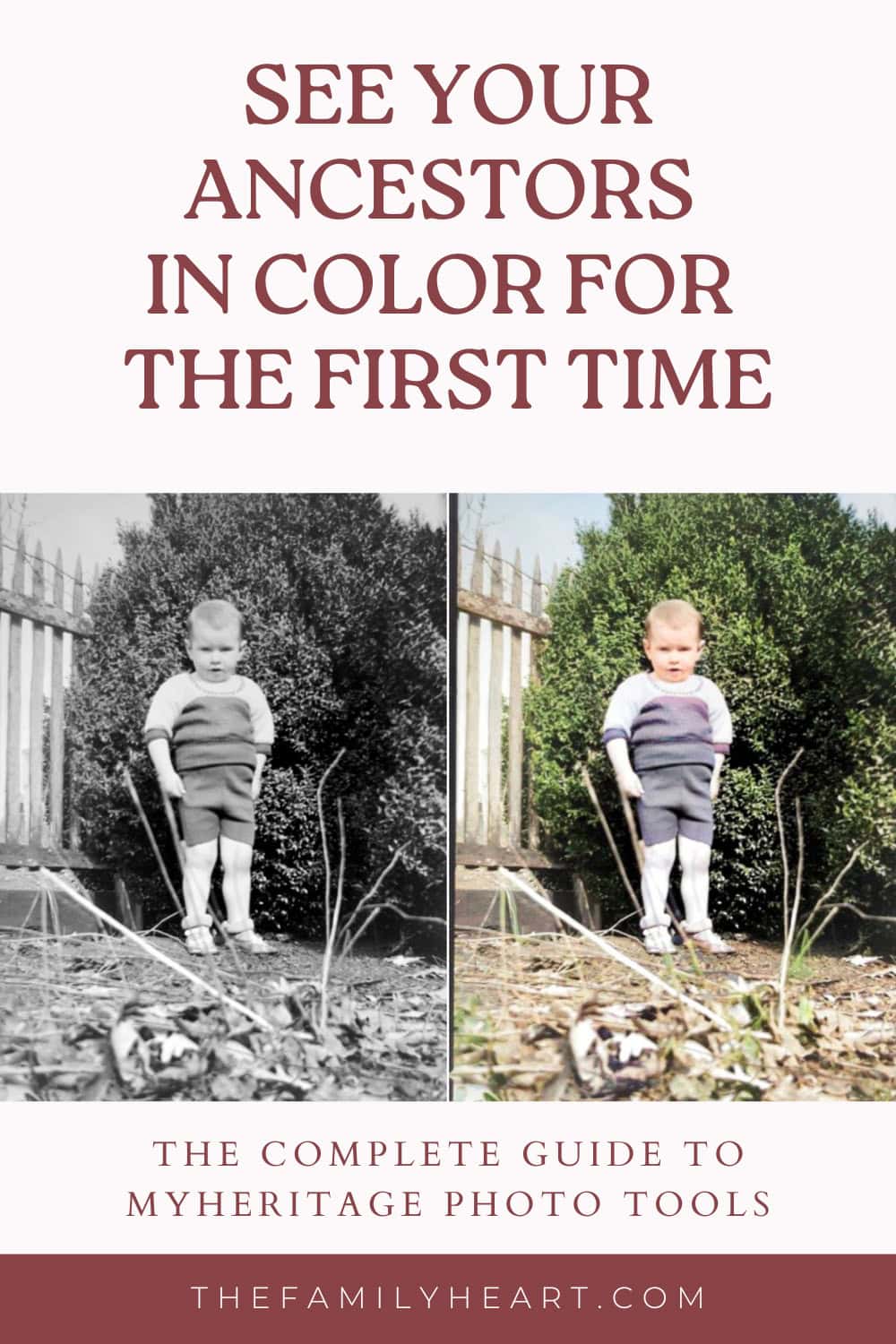
We’ve all got them: drawers full of old family photos in sepia, black-and-white, or faded 1970s Polaroids. The people in them can feel like strangers — flat, distant, not quite real. After all, real people are in color.
MyHeritage In Color™ changed that. Upload a black-and-white photo, and in seconds, AI adds realistic color. Upload a faded color photo from the 1970s or 80s, and it restores the original hues. It’s free to try, takes one click, and can be genuinely emotional.


When I first wrote about this tool back in 2020, it was a standalone novelty. Six years later, MyHeritage has built an entire AI photo suite around it: Photo Enhancer, Photo Repair, Deep Nostalgia, LiveMemory, PhotoDater, and more. As a board-certified genealogist, I’ve tested all of these tools on my own family photos, and I’ll walk you through what works, what doesn’t, and what’s worth your time.
But first, let me tell you about the photo that made me cry.
The photo that made me cry
This cute photo of my mother as a little girl sitting on a pony has been in my collection for years. It’s one of my favorites. When I ran it through MyHeritage In Color™, I wasn’t sure what to expect. Honestly, I couldn’t even imagine what it would look like in color.
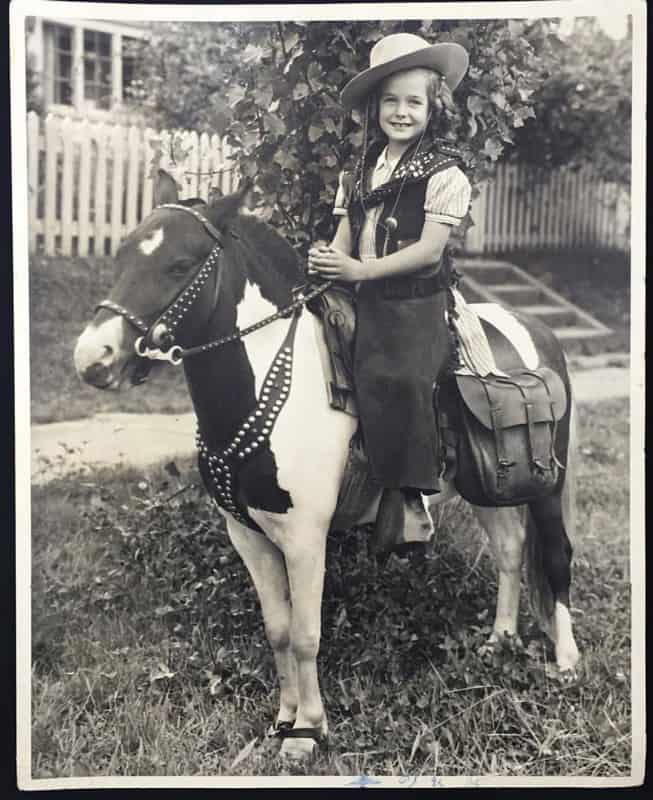
And then, POOF. There was my mother as a little girl sitting on a pony — in living color. It was the first time I’d ever seen a color photo of my mother as a child.
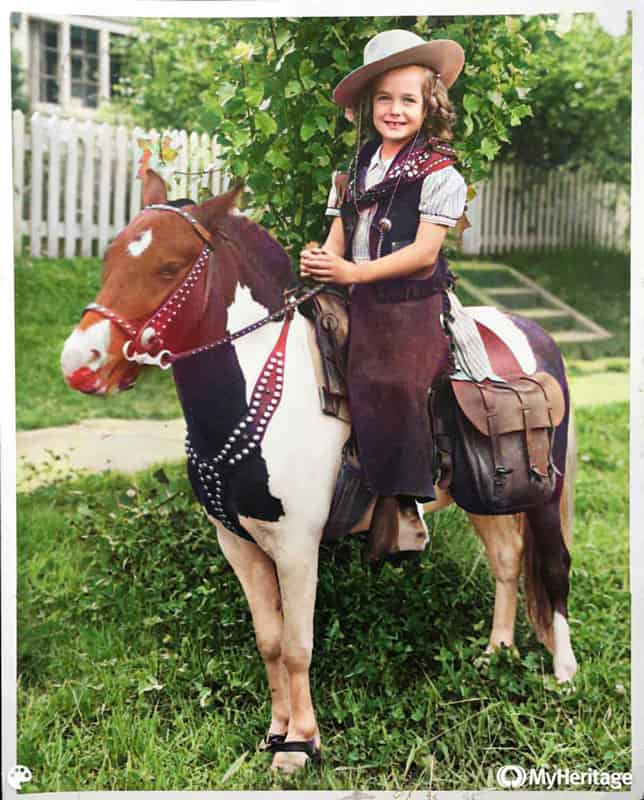
I was playing around with the app on my phone, trying to explain to my half-interested husband what I was doing. The colorized photo popped up when I was in mid-sentence… and I went speechless.
Then the tears started flowing.
There’s just something about a color photo that makes the people in it seem more REAL. My mother’s smiling face, her clothes, the brown-and-white horse (is that lipstick on the horse?), the green grass and trees — details I’d never noticed before suddenly popped out.
I’ve been hooked ever since.
Your mileage may vary (but the tech has come a long way)
When I first tested MyHeritage In Color™ in 2020, results varied widely depending on the source photo. That’s still true in 2026 — but the algorithm has improved noticeably. Photos that produced muddy or washed-out results back then often come out crisp and vivid today. If you tried In Color years ago and weren’t impressed, it’s worth a second look.
Here are a few examples from my own collection, originally colorized in 2020:
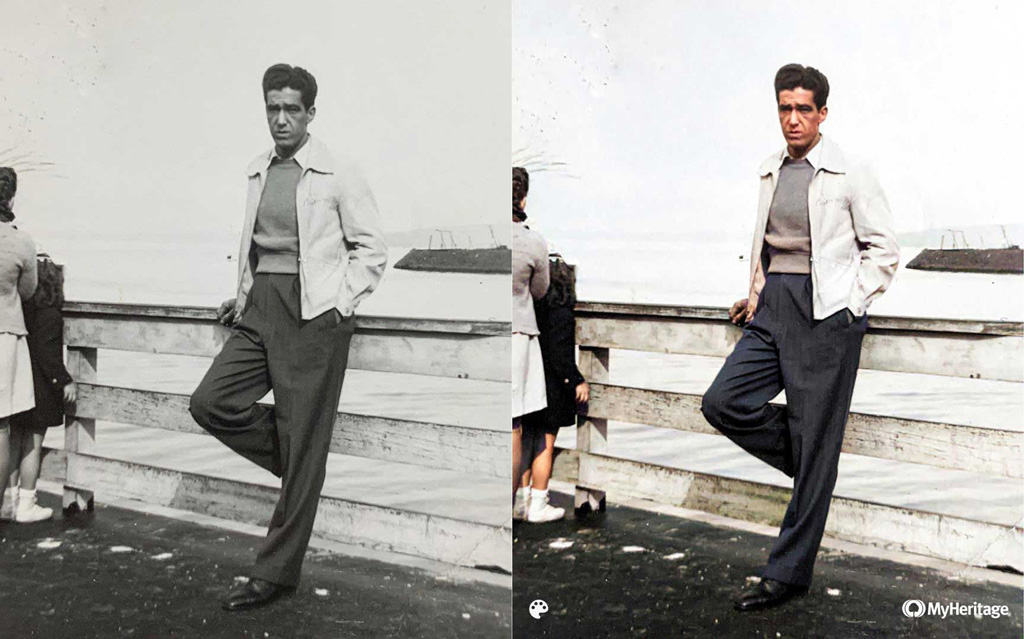
My maternal grandfather, Marvin Dagle (above). He died when my mother was 9 years old, so I never had the chance to know him, and I’d never seen a color photo of him. He was a dapper dresser.
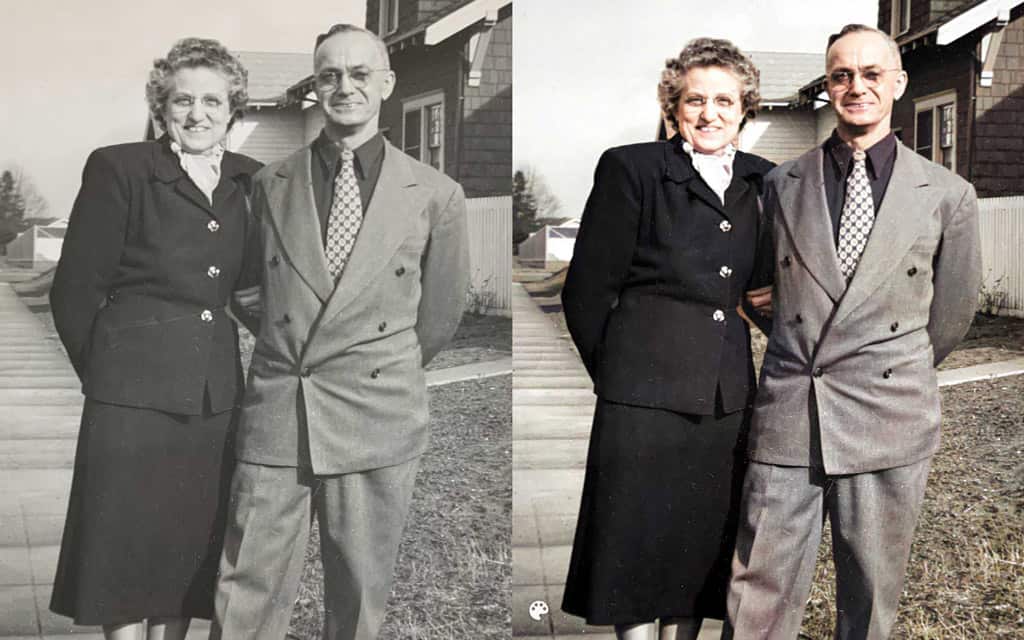
My great-grandparents (Marvin’s parents), Azelia “Zee” Faivre and George Dagle, looking sharp (above). My mother called them “Ma” and “Pa.” I may have met Zee at some point when I was little, but I don’t remember; she died in 1975. George died before I was born.

My paternal grandparents, Reba Dunn and Isaac Lee Swanay (above). They were alive until I was in my late 20s, so I knew them “in color.” There’s a bit of color bleed from the green plants onto Reba in this one — a common quirk of early colorization.
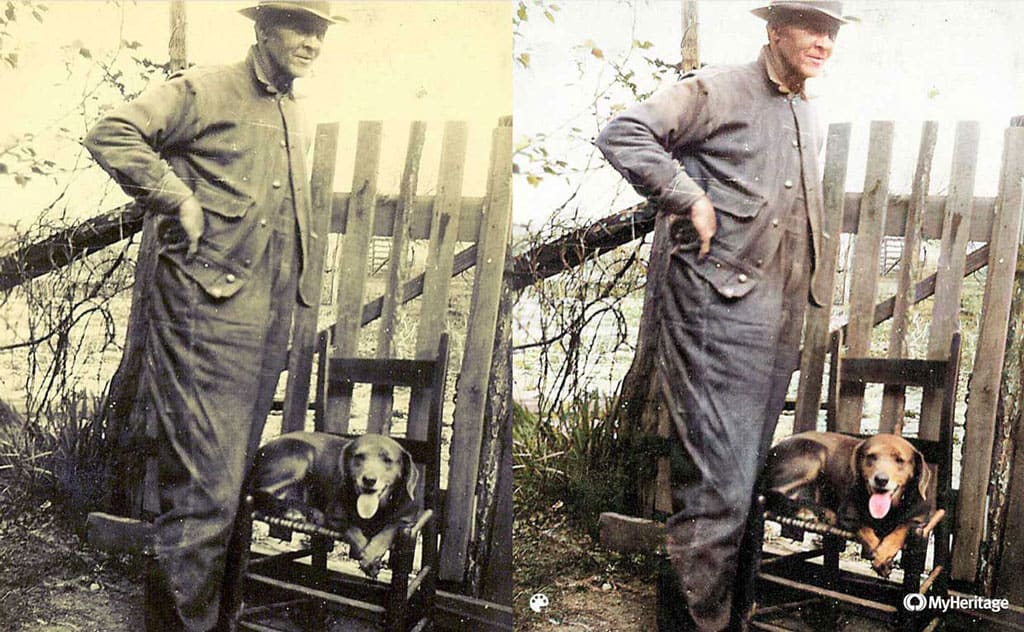
My great-grandfather (Lee Swanay’s father), William Franklin “Frank” Swanay (above). He also died before I was born, and this is one of the only photos I have of him. Can I just say… THAT DOG! I never gave him much notice before, but how cute is he, smiling right into the camera? He really steals the show in the color version.
A few things I’ve learned after six years of using MyHeritage In Color
- Black-and-white photos generally colorize better than heavily yellowed sepia photos. The algorithm has more reliable tonal information to work with.
- The process doesn’t repair damage. Scratches, tears, dust spots, and grain will still be visible in the colorized version. (For that, you’ll want Photo Repair — more on that below.)
- Colors occasionally bleed. I don’t know if Reba’s dress was actually green, but I’m reasonably sure her hair wasn’t.
- Skin tones have improved dramatically since 2020. Early colorizations sometimes gave everyone the same generic complexion; today’s results are more varied and realistic.
- Group photos are harder than portraits. The more faces and backgrounds the algorithm has to interpret, the more opportunities for weirdness.
How to colorize your own photos (step by step)
Step 1: Go to the In Color page
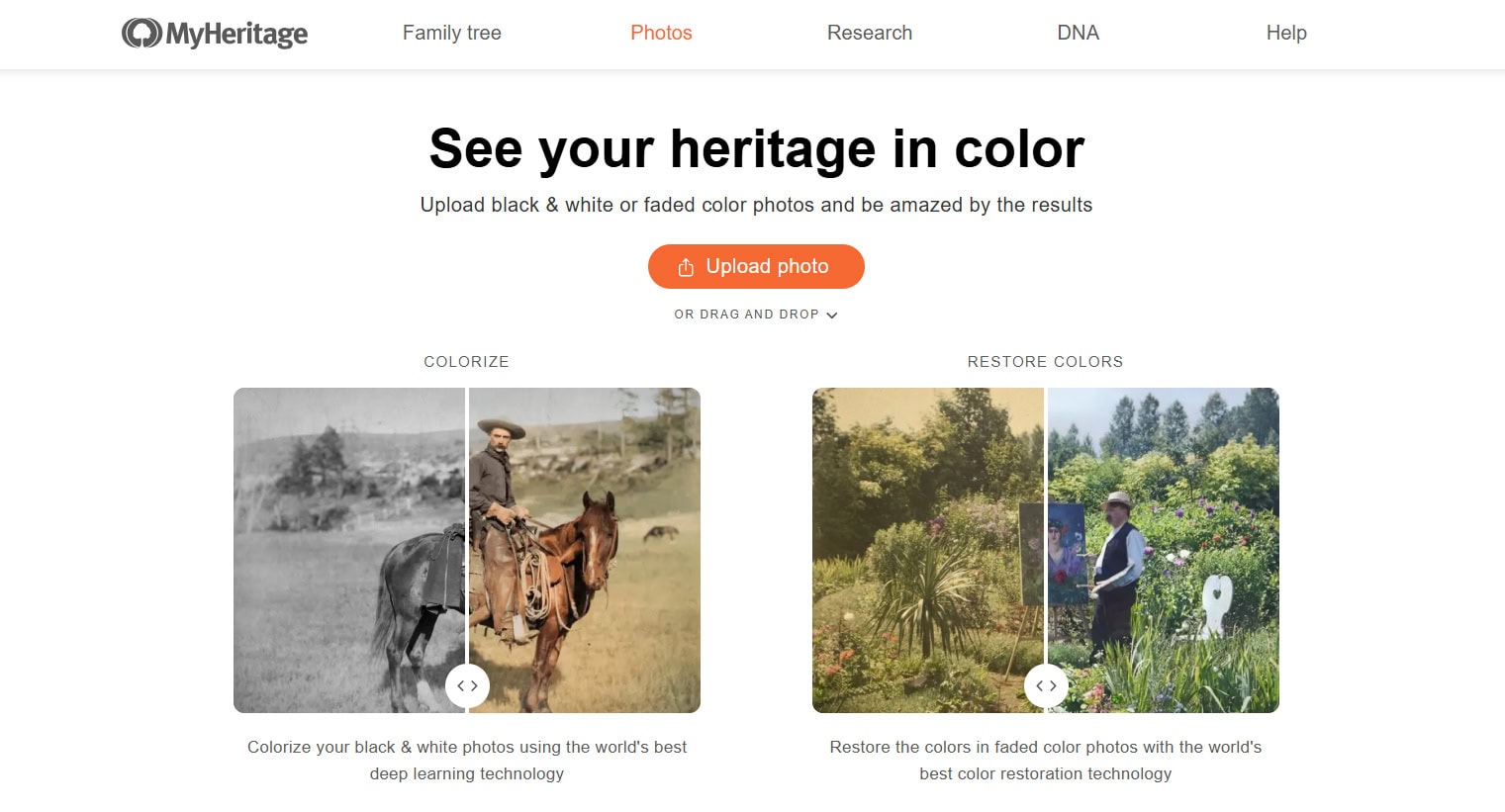
Visit myheritage.com/incolor. You can also get there by hovering over Photos in the main navigation and selecting Colorize photos.
Step 2: Upload your photo
Click the Upload photo button, or simply drag and drop your photo into the frame.
If you’re not already logged in to MyHeritage, you’ll be prompted to sign in or create a free account. A free account is all you need to get started.
A quick tip before you upload: For best results, scan your photo at 300 DPI or higher and crop out as much of the frame, border, or background clutter as possible. The algorithm works best when it can focus on the subject.
Step 3: Let the AI do its thing
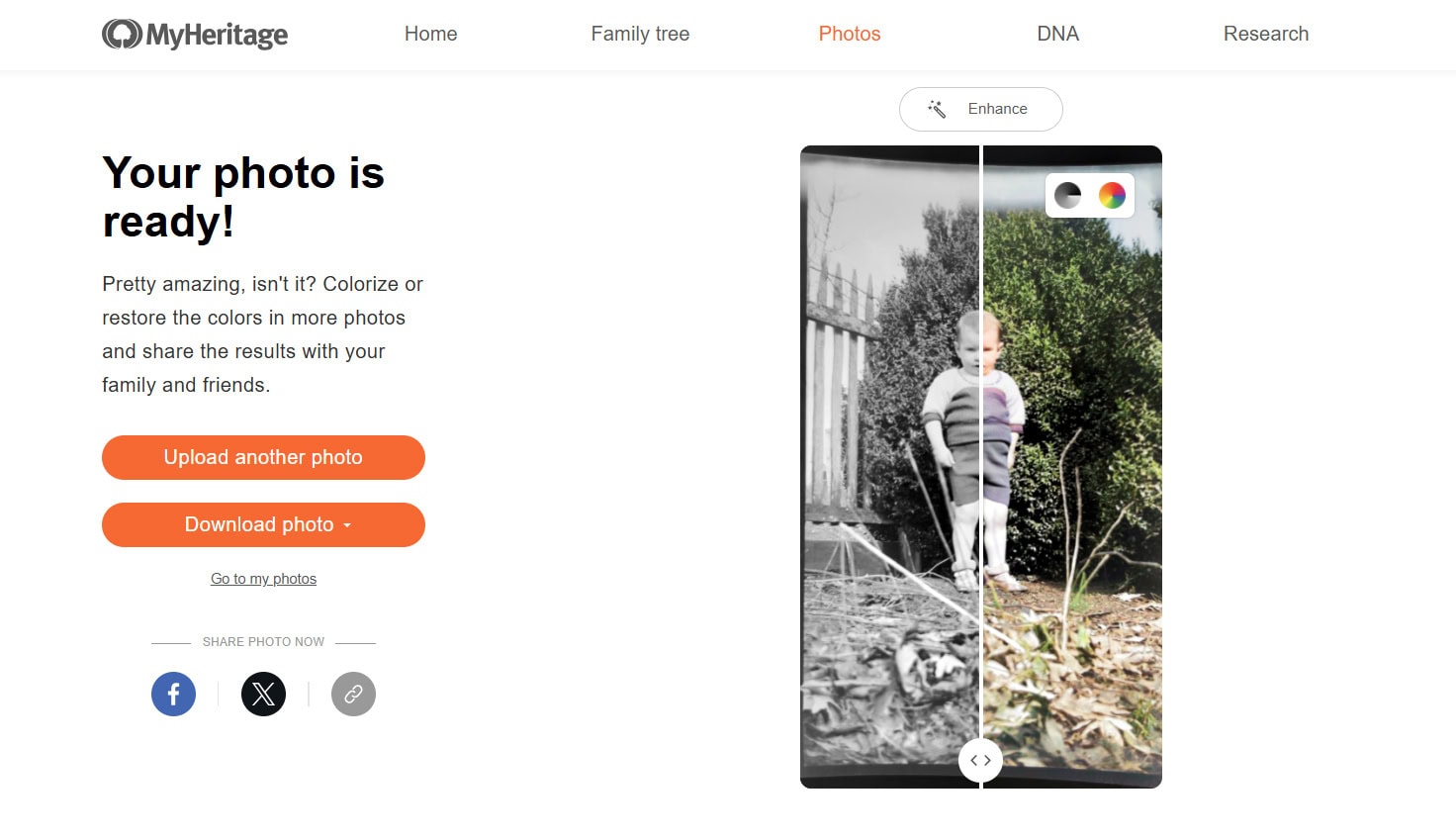
Colorization takes just a few seconds. When it’s done, your photo will pop up on screen with a slider that lets you compare the original and colorized versions side by side. Drag the slider back and forth — it’s genuinely fun and helps you notice details you might have missed.
Step 4: Save, share, or enhance further
From here, you have options:
- Download the colorized photo to your computer or phone
- Share directly to social media
- Apply other MyHeritage tools — you’ll see buttons to enhance, repair, or animate the same photo without re-uploading
Important: If you plan to save the colorized version in the same folder as your original, give it a new filename (e.g., add “-colorized” to the end). This saves you from accidentally overwriting your original. I learned this the hard way.


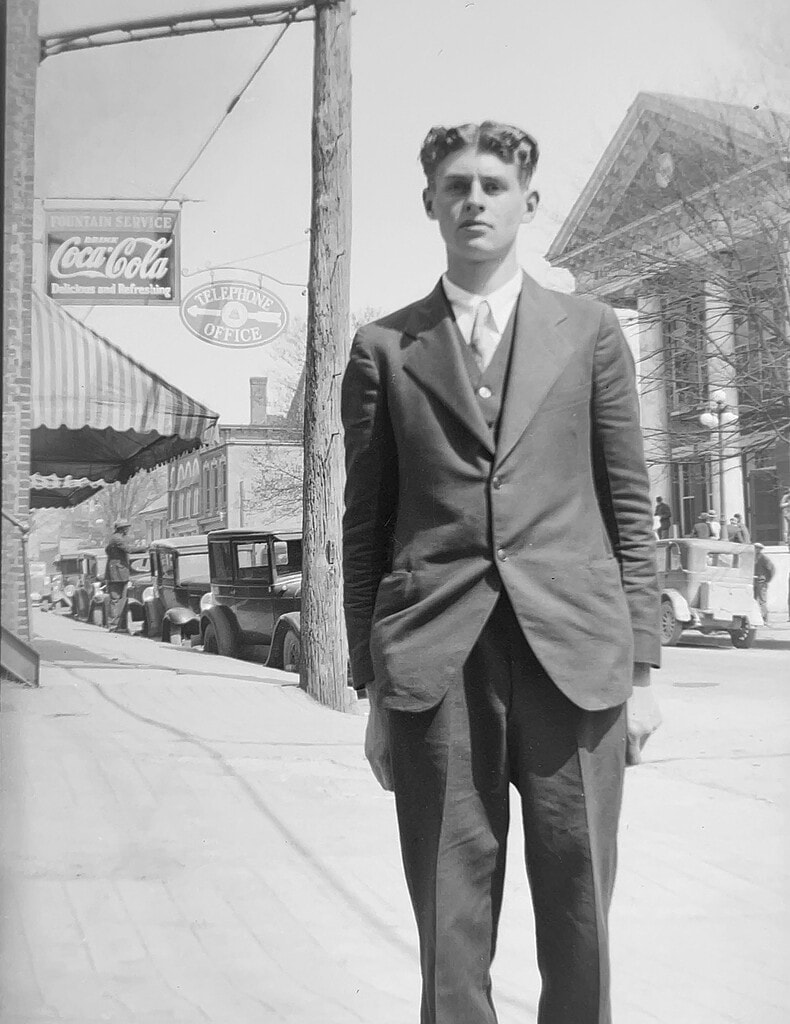
Original image scanned from a 90+ year old negative.
Step 5: Find your photos later
All photos you upload — originals and colorized versions — are stored in your MyHeritage account. To find them later, go to Photos in the main navigation and select My photo gallery.
Is MyHeritage In Color really free?
Yes — with limits. Here’s how it works as of 2026:
- Free accounts can colorize a limited number of photos before hitting a paywall. Free results include a small MyHeritage watermark in the corner.
- Photo plan or Omni plan subscribers get unlimited colorizations with no watermark, plus full access to Photo Enhancer, Photo Repair, Deep Nostalgia, and the Reimagine scanning app.
- LiveMemory (the newest animation feature) is a premium tool with a separate allocation even within paid plans.
Pricing changes periodically, so check the MyHeritage website for the current rates. If you’re on the fence, the free tier is enough to test all the core tools on a handful of your most meaningful photos.
Beyond colorization: The full MyHeritage photo suite
When I first wrote this post in 2020, MyHeritage In Color™ was a standalone feature. Since then, MyHeritage has built one of the most comprehensive AI photo toolkits available to genealogists — and recently streamlined it into a more focused suite. Some of these tools are genuinely useful for research. Others are just plain fun. All of them are worth knowing about.
Here’s the full lineup, in roughly the order I’d recommend trying them.
Photo Enhancer: sharpen blurry faces, fix damage, and restore faded color
If I had to pick the most useful tool in the MyHeritage photo suite for actual genealogical research, this would be it. Photo Enhancer has quietly become the workhorse of the MyHeritage photo suite, absorbing what used to be three separate features — sharpening, repair, and color restoration — into a single tool.
Here’s what it does:
Sharpens blurry faces. Think about every group photo where you can’t quite tell who’s who. Every cabinet card where the subject’s face is slightly soft. Every newspaper clipping where your ancestor is just a smudge of pixels. Photo Enhancer can make those faces identifiable again.
Fixes physical damage. Scratches, creases, tears, water stains, foxing, and missing corners — the AI detects and repairs damage as part of the enhancement process. I’ve used it on photos I thought were beyond saving, and the results still surprise me.
Restores faded color. Upload a faded color photo from the 1970s, 80s, or 90s, and Photo Enhancer will revive the original hues. This is different from colorization — the AI isn’t inventing colors, it’s bringing back what was already there. If you have a closet full of orange-tinted photos from your childhood, this is the tool for you.
A note of caution: Photo Enhancer won’t invent details that aren’t there. The AI doesn’t know what your great-great-grandmother looked like, and extremely damaged or heavily pixelated photos can produce results that look a little “off,” sometimes even generating faces that don’t quite match the original person. Use your genealogist’s eye. If the enhanced version looks wrong, trust your instincts and stick with the original.


Original image scanned from a 90+ year old negative.
Deep Nostalgia™: animate a face in a still photo
Brace yourself before you try this one. Deep Nostalgia™ takes a face in a still photo and animates it — blinking, smiling, turning its head. The first time you see an ancestor “come alive” this way, it’s disorienting in the best possible way.
The tool applies pre-recorded movement sequences (called “driver videos”) to the face in your photo. You can choose from several different sequences to find one that feels right for the person. The results are short — maybe 10 seconds — but they’re powerful.
A word on ethics: Deep Nostalgia is meant for deceased relatives. MyHeritage explicitly asks users not to animate photos of living people without their permission. Some genealogists love this feature; others find it unsettling. Either reaction is valid. Think about how your living family members might feel before sharing widely.
LiveMemory™: animate the entire scene
If Deep Nostalgia animates a face, LiveMemory™ animates the whole photo. It’s the newest and most ambitious tool in the MyHeritage photo suite, released in late 2024, and it genuinely took my breath away the first time I tried it.
LiveMemory turns a still photo into a 5-second video clip. A wedding photo becomes a kiss. A photo of a child on a pony becomes the pony walking forward. A formal family portrait becomes your ancestors shifting, smiling, and interacting with each other. The algorithm even simulates parts of the scene beyond the edges of the original photo, as if the camera is panning.
You can let the AI automatically reenact the scene, or choose from a set of custom animations (hugging, laughing, and a few playful ones like “underwater” or “zero gravity” if you’re feeling silly).
LiveMemory is a premium feature — free users get a small number of animations to try, after which you’ll need a Photo or Omni plan. Given the cost of the technology behind it, I think the free trial is generous enough to let you decide if it’s worth paying for.
PhotoDater™: estimate when a photo was taken
PhotoDater™ analyzes an uploaded photo and estimates the decade (sometimes the specific years) when it was taken. It looks at clothing, hairstyles, photographic style, paper stock, and other visual cues.
It’s not always precise — I’ve seen it miss by a decade or more on unusual photos — but it’s a helpful starting point when you have undated images. For photos with no writing on the back and no context to anchor them, PhotoDater can at least narrow your search window.
Photo Storyteller™: record audio memories with your photos
This is the tool I’d recommend every genealogist use right now, today, with living relatives. Photo Storyteller™ (available in the MyHeritage mobile app) lets you attach up to an hour of audio recording to a photo.
Sit down with your grandmother. Pull up old photos. Hit record. Let her talk.
You won’t regret it. I promise.
Unlike the AI-powered tools, Photo Storyteller isn’t flashy — it’s just audio attached to an image. But for preserving actual family memory in the actual voices of the people who lived it, there’s nothing else like it.

Reimagine app: scan photo albums in bulk
Reimagine is a separate MyHeritage mobile app (not the main MyHeritage app) designed for one specific task: quickly scanning old photos. Point your phone’s camera at a photo album page, and Reimagine automatically detects the edges of each individual photo, separates them, and saves them as standalone images.
If you’ve got shoeboxes or albums full of unscanned photos, this is the fastest way I know to digitize them. Once they’re in the app, you can apply any of the MyHeritage tools (colorize, enhance, repair, animate) without switching platforms.
Pair this with a DIY lightbox for scanning negatives, and you have a complete photo-digitization workflow for under $20.
Which tools are worth paying for?
If you’re wondering where to spend your subscription dollars, here’s my honest take as someone who uses these tools regularly:
- Essential for research: Photo Enhancer, Photo Repair, Photo Storyteller
- Worth it for the emotional impact: In Color, Deep Nostalgia, LiveMemory
- Nice to have: PhotoDater, Reimagine
If you only need occasional access, the free tier is enough to test each tool on a handful of your most important photos. If you’re working through a large collection, a Photo plan or Omni plan pays for itself quickly.
Wrap Up
When I wrote the first version of this post in 2020, I had no idea where MyHeritage’s photo tools would go. At the time, colorization alone felt like magic. Six years later, I can watch my grandmother smile. I can see my great-grandfather’s dog wag his tail. I can hear my mother’s voice attached to a photo I’ve loved my whole life.
That’s not just technology. That’s something closer to a gift.
Are the tools perfect? No. Do they sometimes get things wrong, like give someone brown eyes when they were blue, or put a beard on a woman who definitely didn’t have one? Yes. But the point isn’t perfection. The point is connection. The point is looking at a photograph of someone who died before you were born and, for just a moment, feeling like you almost knew them.
For a free tool (or a very affordable paid one), that’s extraordinary.
If you haven’t tried MyHeritage’s photo tools yet, start here:
- Pick one photo that matters to you — not your most damaged one, not your rarest one, just one you love.
- Go to myheritage.com/incolor and colorize it for free.
- If the result moves you — and I think it will — try Photo Enhancer and Deep Nostalgia on the same photo.
- Come back and tell me in the comments what you discovered.
Because that’s the best part of this whole thing: we’re not just colorizing pixels. We’re remembering people. And that’s what family history has always been about.
Before You Go
Related Posts You Might Like
Have you tried MyHeritage’s photo tools?
Which tool surprised you most? Did a colorized photo make you cry the way my mother’s pony photo made me cry? Did Deep Nostalgia or LiveMemory give you a moment with an ancestor you thought you’d never have?
Share your experience in the comments below. I read every one, and I love hearing your stories.


I have received a complimentary subscription to MyHeritage; however, opinions about their products are my own.
This post contains affiliate links. I may receive a small commission if you choose to make a purchase, but it does not add anything extra to the price you pay. For more, please read my full Disclosure Statement. I appreciate your support!






I was having too much fun trying this after I saw your post. Unfortunately, there seems to be a limit as it stopped me after about a dozen pictures. Some I didn’t save as they colors were a little off. Now, I could probably pay for a one month access and work like crazy to get more colorized.
Wow! Such a stark contrast. You really brought these photos to life. Great work, Elizabeth!
Thank you, parkermccoy!
MyHeritage now has an “Enhance Photos” feature. After colonizing, an icon appears asking if you want to “Enhance” your colonized photo. It will sharpen and “smooth” out most pictures and is quite amazing. However, it depends on the quality of the original, so you need to check which version you prefer. Truly amazing technology.
Hi Roger! I use the Enhance feature all the time and have shared several Enhanced photos on Instagram (@elizabeth_oneal). This post was written before MyHeritage released the Enhance feature so I should probably update the post or write another one about Enhance. It’s a great feature, although I’ve noticed it really only enhances faces, and as you said, the results depend on the quality of the original. On one photo, it gave brown eyes to a blue-eyed individual, and on another photo, it kept trying to put a beard on a woman who I’m pretty confident did not have one! 😛
I COLORIZED PICTURES WHERE THERE WAS BLUE AND ALL OF THEM PAINTED THEM BEIGE! COLORS NEED MORE WORK BEFORE PROGRAM CAN TRULY COLORIZE!
You’re right, Pierre… the program isn’t perfect. And it does a better job on some images than on others. But it’s definitely a good start, especially for free (10 images are free)!
Uploading a few photo’s is free.
But then you have to become a payed membership.
So it is not free.
Hi Peter! You can colorize or enhance up to 10 photos for free. Beyond that, you’re right, you do need to have a paid subscription.
Enhance image quality online for free https://freetools.site/image-editors/enhance-quality